Barckwords

Barckwords
Click logo above to see more about Barckmann's fiction

Tuesday, June 26, 2018

Red Sparrow, Palace of Treason, and other CIA Fantasies

Jason Matthews, born in 1951, looks and talks a bit like Leon Panetta, who ran the CIA for a while during the Obama Administration. In other words, he doesn’t  look like a “Jason Bourne” type spy. He is the author of two very popular spy novels, mentioned in the title of this post. His first novel Red Sparrow was made into a movie this year, (2018).  I give it a so-so rating. The second one Palace of Treason is only slightly better.


The novels are of great interest because Matthews updates us on some of the clandestine techniques of both the Russian and American intelligence agencies. As a former spook himself, Matthews writes quite openly about the internal battles within the American Intel world (CIA vs FBI, with DIA, NSA, and NIC all having peculiar minor roles with their characters and quirks.).  Matthews is a sharp intellect, and is a competent, if unlyrical writer who obviously has a broad range of non-spy related interests. The novels are filled with many Russian latinized phrases that show Matthews’ command of русский (russkiy).


One recurring feature in the novels, is that at the end of every chapter Matthews has a culinary recipe, usually of some Russian or Middle Eastern dish but sometimes just sandwiches or salads. He started this in Red Sparrow and continued it through his second book, Palace of Treason.  That means that every chapter has to have an eating scene, because the recipes reflect the most recent meal consumed in the story. This actually puts Matthews in a narrative box.  Eating is important of course, but most novels don’t have a meal stuffed into every chapter. I suppose this is entertaining and informative for some readers, but I find it annoying and think it detracts from the flow of the story.


The main character is Dominika Egorova, the beautiful young niece of the one of the department heads of the Russian SVR (Sluzhba vneshney razvedki or Foreign Intelligence Service). She has powers that rival Wonder Woman's  “...Dominika was born a synesthete, with a brain wired to see colored auras around people and thereby read passion, treachery, fear, or deception.” She is a former Prima Ballerina for the Bolshoi, highly connected into the Russian power structure, and who speaks fluent French and English and can practically read other people’s mind.  And because she is a graduate of State School Number 4, Sparrow School, or as she calls it “whore school” she is a master of sexual technique and the art of bringing maximum pleasure to her lovers.


Her counterpart is Nate Nash, a son of a Virginia lawyer who turns away from a life of mint juleps and horse country leisure, to serve his country. He is brave, resourceful and speaks Russian. His task in Red Sparrow is to manage the relationship with the Russian Mole, MARBLE, a high official in the Russian Intelligence Service, with access to the highest level of Russian policy, a position similar to that of Bill Haydon in Le Carre’s Tinker Tailor, Soldier Spy.


Red Sparrow got rave reviews from former CIA officials and the refrain from the mainstream reviewers is that it is an authentic and realistic account of the Spy vs. Spy battles being waged today. Red Sparrows were (usually) women who were trained to use sexual attraction to flip their targets. Both novels are filled with details of “tradecraft”. Honey Traps, (compromising with sex), Rapid burst transmission, (Condensed encrypted radio transmissions) and the Canary Traps (where you leak different secrets to different mole targets to see which info (canary) flies home, thereby identifying the mole) Window dressing, (a cover story for spies to convince the opposition that what they are seeing is genuine, rather than a set-up.)  Much of this tradecraft has already been deeply explored by Le Carre.


Matthews writes long books.  Both books together are over one thousand pages in soft cover. So he gives his readers their monies worth.


His competition, at least if you read what some reviewers say, is John Le Carre who invented the genre.  Tradecraft terms like Mole, Dead drop, brushpast, lamplighters, scalphunters, sleeper agents, all of these phrases and many more were invented by Le Carre.  Now everyone, including the spies themselves, use these terms to describe the various facets and specialties of modern spying.


One thing that separates them is that Matthews was  62 when he published his first book, while Le Carre (JLC) was still in his twenties when he began writing fiction.  Being a Brit JLC was also a bit more elegant in his storytelling. Matthews gets right to the short strokes like he is composing a cable back to headquarters detailing the state of his case. JLC takes his time and gives space for even his minor characters to blossom.


I think a lot of people who support our INTEL community see Matthews’ novels as a forceful answer to Le Carre.  Throughout LeCarre’s work there is an anti-American subtext. Sometimes it was just smug, pointing out the clumsy American over-reliance on gadgets and gizmos and lack of finesse on the human elements of spycraft.   Other times it is more pointed, wondering if the American INTELs had a vested interest in maintaining the game and overestimating Russia’s capabilities. Le Carre saw that in order to maintain the military funding the US had to have a big evil boogie man to arm against and so therefore it was in the CIA’s interest to make the threat bigger than it really was.


You get no such doubts from Matthews. His Russians are either evil, (Putin makes an appearance in Palace of Treason) sadistic, or lackey stooges.   


Well - except for our super girl Dominika and the American Mole in the Russian infrastructure. Both of them represent all that is good and cultured in Russia. Both of them are traitors to their country, but Matthews paints them as people who have been dehumanized first by the Soviet system, and now by Putin’s.  But how helping the Americans win (win what?) is not made clear. With Dominika we do get to see some complexity. She is a killer, and she is good at it. But she loves Nate, (and sometimes hates him) her American spy (they both are assigned to watch the other by their respective agencies). But other than her longing to be with Nate, she is motivated by hatred of her Kremlin masters.


These days, it is hard to put a political label on these books, although the arch American traitor is a woman Democratic Senator from California, so I think it is pretty clear where Matthews probably stands.  But with Trump, who is (IMO) partially a creation of the Russian Intel services, many liberals look to the CIA et al as one of the institutional backstops against the creeping fascism that Trump represents.  But it is not that simple. If the election of Trump was the ultimate spy coup of modern history then what does it say about our services which allowed it to happen? Doesn’t it indicate that Le Carre is right, that our guys are queer for the gear, but that are clueless as to what is really at stake?  


What is at stake in Matthews books?  New satellite technology (gear) that the Democratic Senator is selling to the Kremlin. Or (shades of Tom Clancy) submarine schematics. Meanwhile, our democracy got hacked in a big way. This seems to escape Matthews notice, although he seems to promise to address it in his third book in the trilogy The Kremlin's Candidate.  We’ll have to wait until it comes out to see.  But the summary from Kirkus Reviews doesn’t seem too promising.


And then there is the movie Red Sparrow.  Poor Jennifer Lawrence.  I felt so sorry for her as she spread her legs in every other scene for men that she hated.  It was an inspired performance, but for what? The other cameos by Jeremy Irons (a Russian General), Charlotte Rampling ( the Matron of the Sparrow school) and Mary Louise Parker (who seemed to think it was a sequel to Weeds as she stumbled around as  the corrupt American traitor) they all gave a perfect definition of “mailing it in”.  In fact, it almost seemed like they were hanging poor Jennifer out to dry, (which is what both the Russians and Americans did in the story.) It was a long, disjointed and boring movie, and I read the book and knew what was happening.  I can’t imagine watching otherwise.


Anyway, my final thought is if that if this is the best we can do to “advertise” our Intel agencies, then maybe Trump is right about the CIA.  No. No. Oh my gosh, I didn’t really say that, did I? These are not happy times.

Sunday, June 3, 2018

Review of The Killer Angels

 
by


It is surprising to me that I have waited so long to read Michael 
Shaara’s epic story of the Battle of Gettysburg, published in 1974.
I visited the battlefield a long time ago, and "The Killer Angels" is about
that land. It is a story about the actual place because topography
is the real determining factor in the battle. You can see how Sharra 
imagined the battle as he walked over it on vacation with his family,
which he says is the spark for his decision to write the book.

The story takes place over the three-day battle and is told through the eyes of a few of its participants. There is a Confederate spy named Harrison who works for General Longstreet, General Lee’s second in command. Those three and the Confederate General Armistead speak for the Confederacy in the story.

Harrison hangs around taverns and Union camps and picks up gossip about Union movements and lets Longstreet know that the North's Army of the Potomac is closing in on the Army of Northern Virginia which is invading Pennsylvania. Harrison is an actor by trade and is a fictional creation of Shaara, because he appears nowhere else in the historical record. But in fact, there was a spy who told Longstreet about the Union movements.

General Buford, a horse soldier, and Colonel Lawrence Chamberlain, a professor of “rhetoric” at Bowdoin College in Maine speak for the north. General Buford's cavalry division is the first to arrive in Gettysburg which is the nexus point of about seven or eight main roads coming from all directions. It is surrounded by ridges, whose names have come to be legendary in American history - Seminary Ridge, Cemetery Ridge, and some rocky outcroppings, Little and Big Roundtop. Buford can see the coming battle and knows the importance of land and of the relative defensibility of high ground. He knows he will soon be vastly outnumbered and that he has to hold the high ground for the Union Army behind him.

It is Chamberlain who starts off the tale by talking a company of deserters out of sitting out the coming battle. He is a silver-tongued orator, conversant in Latin, Greek and is knowledgeable of the great speeches Cicero to Shakespeare, but his talk to the deserters is very basic and down to earth and he convinces all but 4 of the 100 plus men to join his regiment. Chamberlain would then be assigned to defend the far left end of the Union line on Little Round Top. He will hold it on the second day, barely, and the 100 deserters who joined him probably made the difference. If they would have broken and the Rebs had taken the hill, they would have decimated the Union line with artillery and the battle and the War would have been lost.

These are big armies - Lee has 75,000 troops and General Meade, the newly appointed Union commander has 90,000 troops. While the enormity of the battle and casualties (one in three from both armies were killed or wounded) is hard to grasp, Shaara’s book focuses on the psychological pain and suffering of his main characters, and the real greatness of the book is the peek into the minds of the participants. It is more than just believable, it is a great insight into the mind of everyone who has had to contemplate horrible alternatives. The mental strain of General’s Lee and Longstreet is depicted with unusual detail. Shaara mixes the pain from their personal lives, (Longstreet had recently lost all three of his children to an epidemic in Richmond and is fighting to keep the blackness of that event back, away from his thoughts) with immediacy and consequences of their every minor decision. He contrasts General Lee with Longstreet, who is a taciturn, pessimistic grinder, and is years ahead of his times as a military thinker. Longstreet understands that the nature of warfare had changed since Napoleon. Lee, by contrast, believes in honor and character, and that will power and gallantry will eventually be the determining factor in the war.  But Longstreet does the math and can calculate his casualties before the fight based on the estimated firepower opposing him. Longstreet wants Lee to dig in, and let the fight come to him. Lee rejects this and he is the boss. Longstreet almost quits, but his black haunted pain of his lost children somehow makes staying on acceptable.

One of the other interesting points of the novel is that Shaara puts Lee’s heart condition into the mix. Shaara had had a heart attack a few years before he wrote “The Killer Angels” and would eventually die from heart failure. Shaara knows exactly how a failing heart weakens a person’s endurance and psychological outlook, and he makes that one of the salience aspects of Lee’s distracted thought process during the battle.

Many of the other famous participants in the battle show up and reveal themselves. General Pickett is a boy who never grew up. He is dancing and singing before leading 15,000 men up that mile long hill into the teeth of the Union cannon-canister blasts. General Reynolds, who refused Lincoln’s offer to command the entire Army of the Potomac just days before, (allowing it to go to Meade) is a powerful presence who on the first day of the battle and is in the process of helping Buford place his units on the field when he is killed by a sniper. Armistead, who briefly captures some of the Union guns at the end of "Pickett's Charge" at the “high watermark of the Confederacy” on Seminary Ridge, sees his wild attack as a last chance to see his best friend, General Hancock, who commands the Union Corp defending that ridge. But he dies before Hancock gets there.

There are discussions around campfires about what it all means. To Chamberlain the war is clearly about slavery and his explanation why is profoundly convincing. Longstreet knows the war is about slavery too, and it haunts him nearly as much as his dead children. Lee also knows, but he says “we must not think on that.” And then you hear them all think about the nature of war itself. And in spite of the horror, all of Shaara's characters, north, and south, acknowledge in one way or another that war is magnificent, that it projects great power on men's outlook and character, binding men together and its exhilaration is second to no other experience they will ever have.

For me, who avoided Vietnam in college and strongly protested its continuance, my battlefield was a campus on lockdown, under curfew, running from the National Guard in the days just after Kent State. Of course, it was nothing at all like war. But it makes me think that that exhilaration, that incomparable feeling of comradeship that soldiers feel for the man next to them is really the enemy, that feeling is really what keeps us marching off to fight. Leftist analysis says it is the capitalist arms manufacturers and their willing tools in Congress and the press who drive us to war. But I think it is that sense of phony romanticism that soldiers remember from the heat of battle, that psychological state of mind that is revealed at Gettysburg, that that is the “Devil’s Den” that really makes war a continuous inevitably.

He's the universal soldier and he really is to blame
His orders come from far away no more
They come from here and there and you and me
And brothers can't you see
This is not the way we put an end to war.

Buffy St Marie

Friday, April 6, 2018

My Visit to a Beijing Police Station

Farewell the Dragon 

I was in Beijing last spring (2017). It was the first time I had returned to the Chinese capital in nearly thirty years. It was part of a two-month train trip, by way of Saigon north through Hanoi and other cities, then on to Siberia, heading across Russia by train. I planned to stay five days in Beijing, the city where I lived in the 1980s. I arrived at the train station from Xian, (the new station, Beijing West in the Fengtai District). My hotel was over near Jianguomen Wai, so I took the subway, and  I missed the stop. But it was a nice day and I walked the rest of the way to my hotel.

I had people to see, dinners to go to with old friends, former students, and their families. I was going to see some of them for the first time in decades. While in Xian, by incredible coincidence, I had re-established contact with the widow of a close friend  There were other friends that I met as well and our reunions were fantastic, and are now lifelong memories.

By my second day there,  I was chomping at the bit to explore my own. A former student brought me over to his office in the business complex that sits where the old “Friendship Store” used to be on Jianguomen Wai, which is actually the eastern end of the main street through Beijing, Chang 'An Dajie. I hung around his office, watching him do business on the phone. I would have loved to have to listen in more, but I only had three more days, and I wanted to head out on my bicycle. We made plans for dinner later so he came outside and paid for a rental bike for me with his smartphone WeChat app and off I went, heading west. I was aiming toward the University district, Haidian Qu, about seven miles away, where I used to live and teach.

At Wangfujing, I took a little detour up the ancient road known since the early Ming dynasty as the market street, the place to go to buy anything available in China, books, clothes, food, furniture, jewelry, toys.  There really are no shops left like in the old days, the real estate is too pricey. They had widened the street and turned it into a pedestrian mall, and it was mostly populated by the same high-end stores you see on Fifth Avenue in New York. There are some indoor malls with shops, but I didn’t linger and headed back to Chang’An. The old food court alley one street down from the Beijing Hotel was still in business, although clearly tamer and not nearly as ‘earthy’ as it used to be. But street food none the less, so I noted it as a place to go when I got hungry later.

Militia forces (People’s Liberation Army, (dark blue uniforms) and People’s Armed Police, (green), as well as local cops (light blue) were everywhere. The closer you get to Tiananmen, the more you see soldiers, usually in groups of 5-10, but always at least two, wearing crisp, ironed uniforms either at rigid attention or marching in step along the street. I didn’t see soldiers in any of the cities in the south or in Xian for that matter, which was teeming with tourists for the May First holiday when I was there. I never saw troops in the streets like this when I was here in the eighties either.


Plain-clothes security was patrolling too, checking IDs of poor Chinese rural families who sat on the sidewalk while being processed into paddy wagons. I rode passed the Beijing Hotel and noted where the young man in the white shirt had stood, facing down the column of tanks. I looked, but there were no tread marks on the street.

On left was the National History Museum.  Now it was a polished marble tomb full of uninspiring kitschy pablum, “realistic” statues of Chinese philosophers and poets that all had the same empty expressions, dumbed down exhibits that would offend or excite no one.
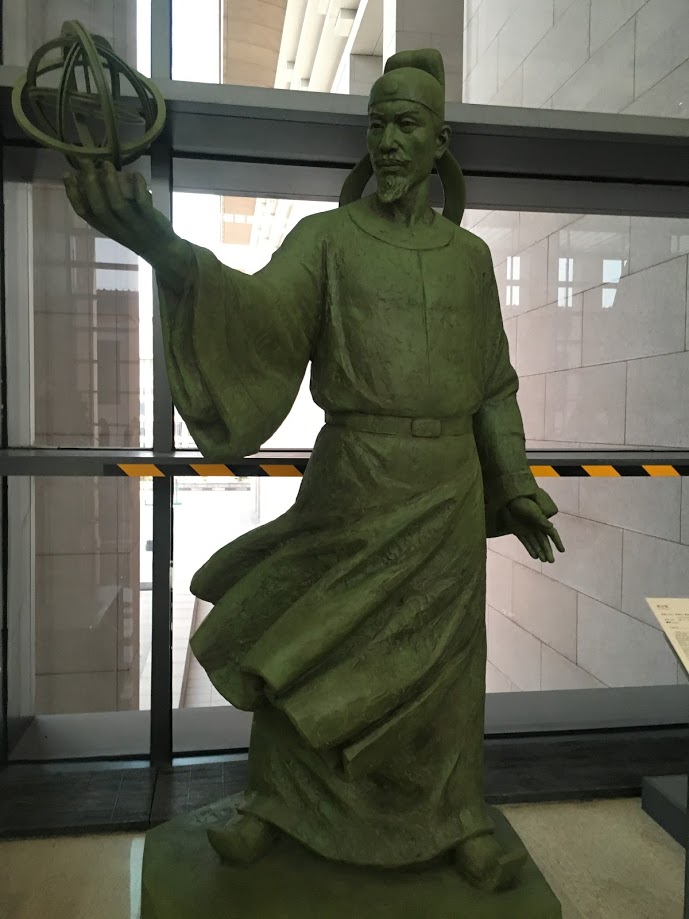


The museum lobby had the feel of a corporate headquarters. It was very forgettable, in fact, as I think about it now, my memory of what it had been in the 1980s is much more vivid than what I had just seen. Today the marble on the staircase cast reflected light, brightening the front hall adding to a sense of spacious emptiness.
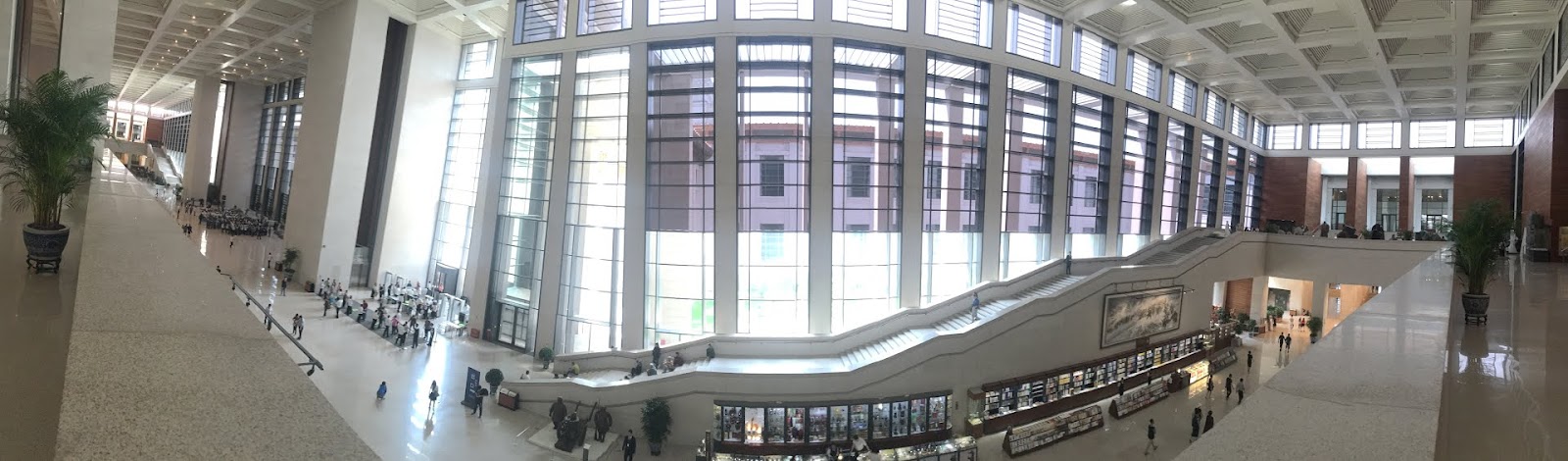


The one funny thing, was right near the entrance, next to the bathrooms.
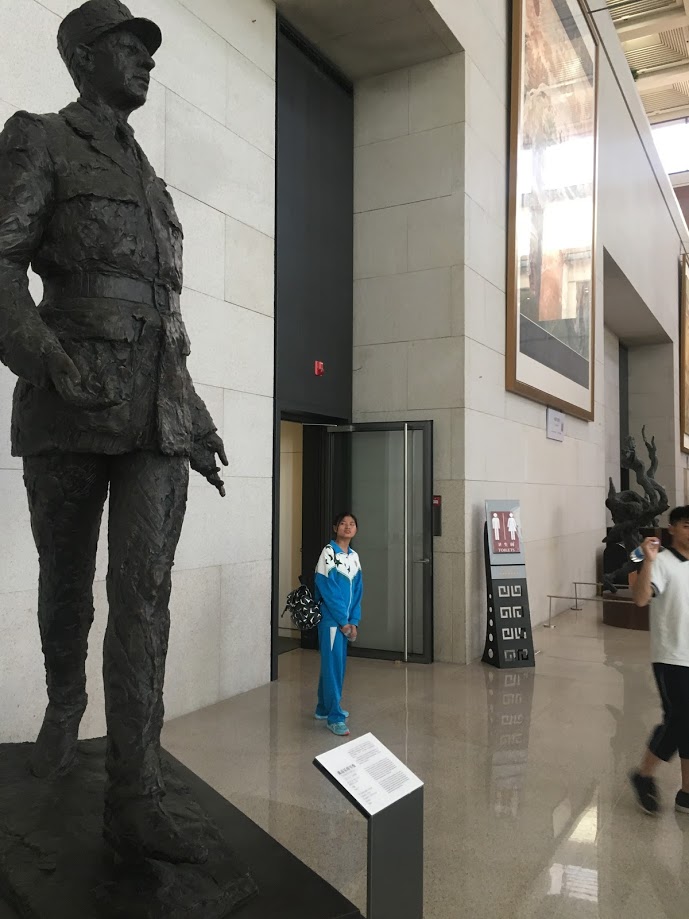


It was a statue of Charles De Gaulle. He has his left hand out, right by where people exit the toilet. With his uniform, it would be easy to mistake him for a very tall men’s room attendant.

The old museum, from the 1980s, of which I have no pictures, had overflowed with exhibits of early 20th century demonstrations and atrocities. It was 100% dedicated to the Revolution and the Party as it saw itself during its days in Yanan, before it took power when it was full of self-righteous zeal. In the old days you would see middle-aged old ladies pushing dirty wet mops around exhibits of weapons and PLA manikins, and paper mache dioramas of battlefields, as well as the real stuff, such as the actual gallows that hanged Li Dazhao, a charismatic leftwing intellectual, in the late 20s, or the pile of real bones from a massacre the name or year of which I forgot. There was replaying in a loop of footage of Japanese soldiers burying Chinese alive in Nanjing. The exhibit’s captions were often handwritten and each exhibit had its own personality, unlike the bland uniformity of what is there now. In the old days the Gongchandang, the Communists, went to great lengths to show solidarity with all of the ethnic groups of China. Now the museum was almost exclusively celebrating the history of the Han people. Anyway, the new Museum is beautiful, architecturally, and I guess it is pleasing to my uneducated eye. Grand, might be an accurate label, but not intimate as it was in the old days. I am not in the least bit sentimental about the early days of Chinese Communism, but there was a certain authenticity that is missing today.

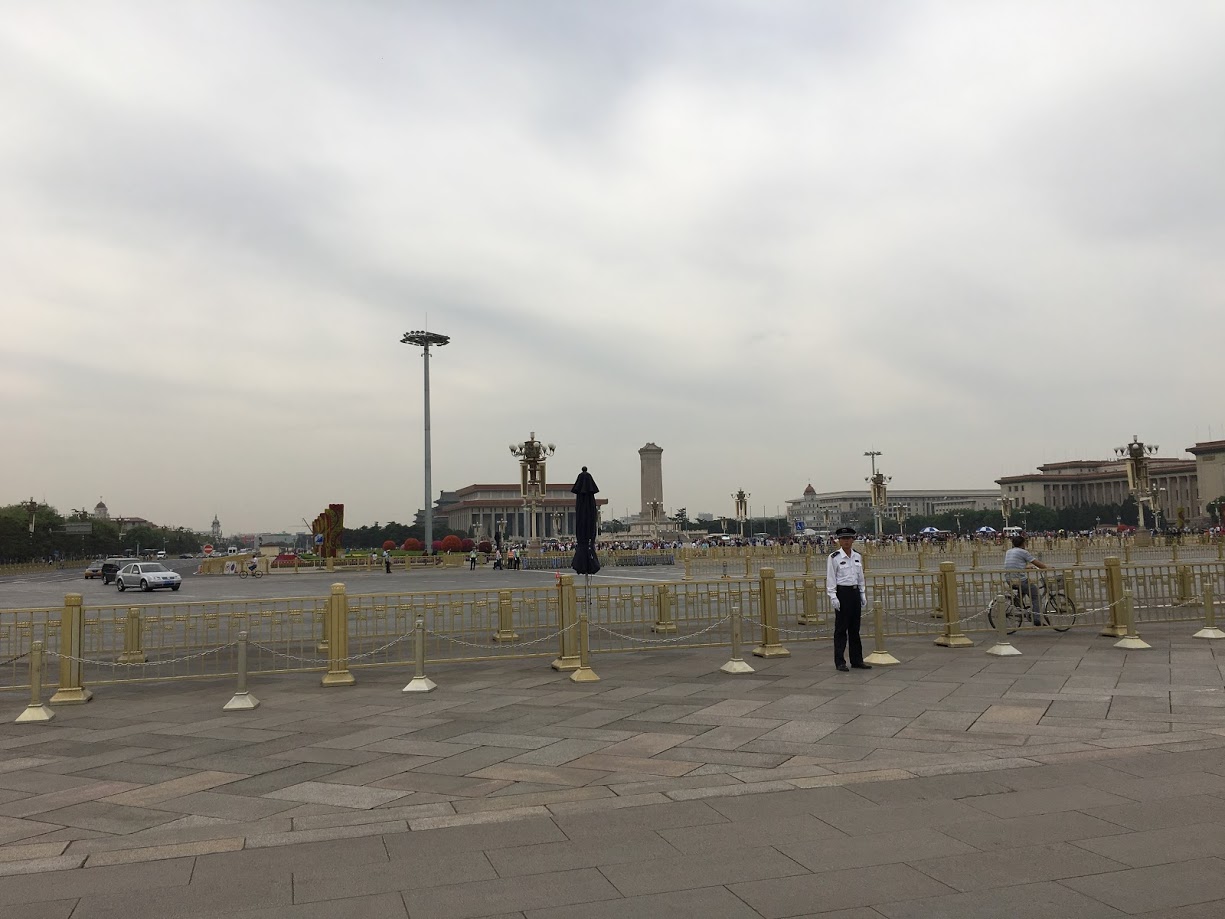
From my bicycle, on Chang’An near Tiananmen, I could see that most of the people on the street were Chinese tourists, identified by badges around their necks from tour groups. Mao’s picture and the Forbidden City were the main draw. I stopped and straddled my bike to take a picture, but was quickly shooed along by a security guard. It is hard to believe a space so big could be watched so closely. When I lived in Beijing I used to come down to Tiananmen and wander around, taking what was then a relaxed and unhyped atmosphere. Now the symbolism of the place overwhelms the place itself.
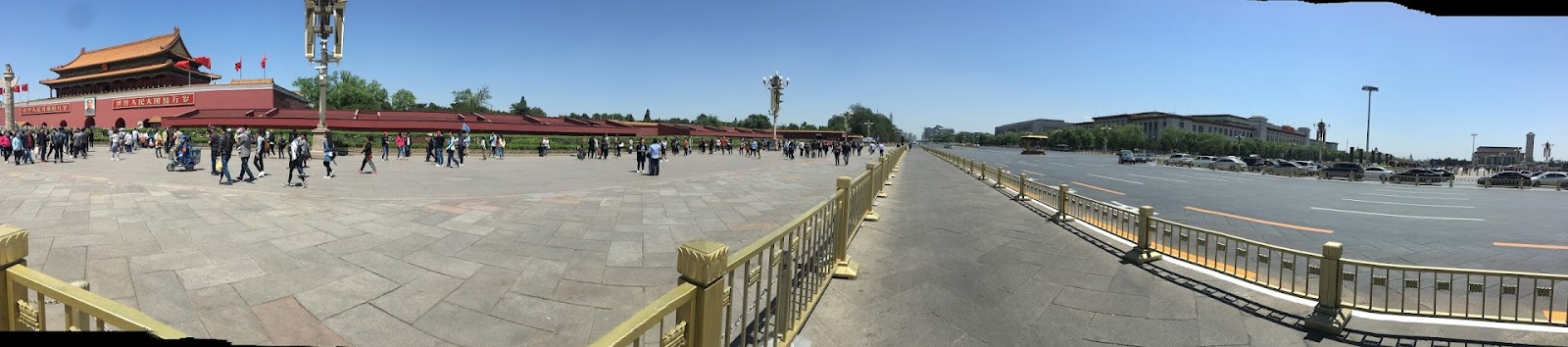


After passing Mao’s picture, the Great Hall of the People is on the left, a massive, Sino-Stalinist style Government Center, where the National Congress meets every few years and where foreign dignitaries are greeted. To my right is Nan Chang Jie, the street between the Forbidden City and Zhongnanhai, the ‘Kremlin’ or true center of power for China. In the eighties, you could ride your bike through this narrow street, which at the time seemed almost like an alley. I think it was closed permanently to non-official traffic after the Falong Gong held a massive rally where 10,000 people surrounded Zhongnanhai. I rode my bike up to the road but was quickly warned away by a guard. A key scene in my novel Farewell the Dragon takes place in the middle of this now ‘forbidden’ street.

And over on the left, just passed the Great Hall is the new National Theater.
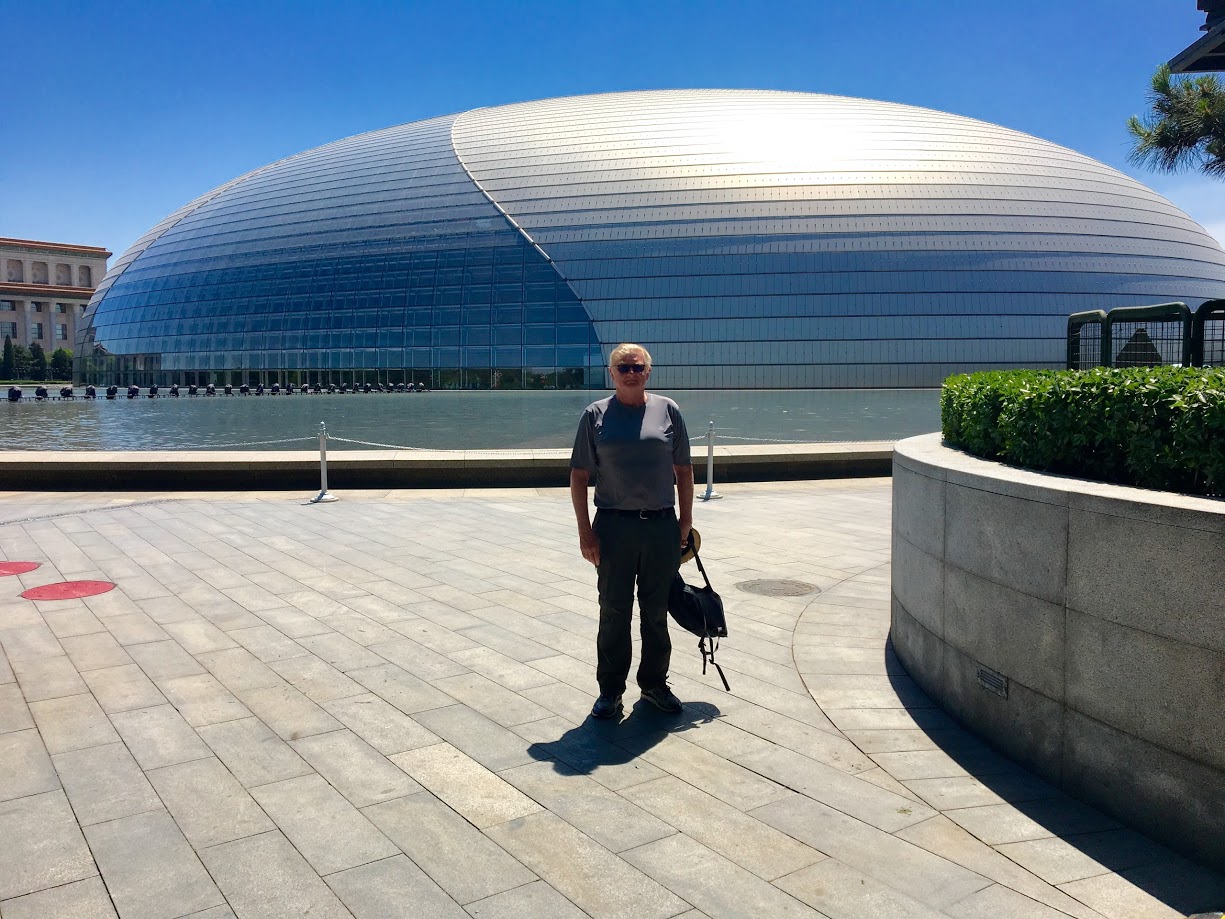


I spent an afternoon there with one of my friends watching a concert. It really is beautiful with an half-egg-shaped exterior.  I think it is the first public building in Beijing that breaks out of the various struggles of the twentieth century, from the fall of the Qing (1911) - to Tiananmen (1989) and looks ahead rather than back.



Inside are massive exhibits.  The Viking-like ship in the lobby is historically ambiguous to me. I have never seen a picture of an ancient Chinese ship like that.  It was not the design of Zheng He's ships of exploration.  Not sure what it suppose to represent.
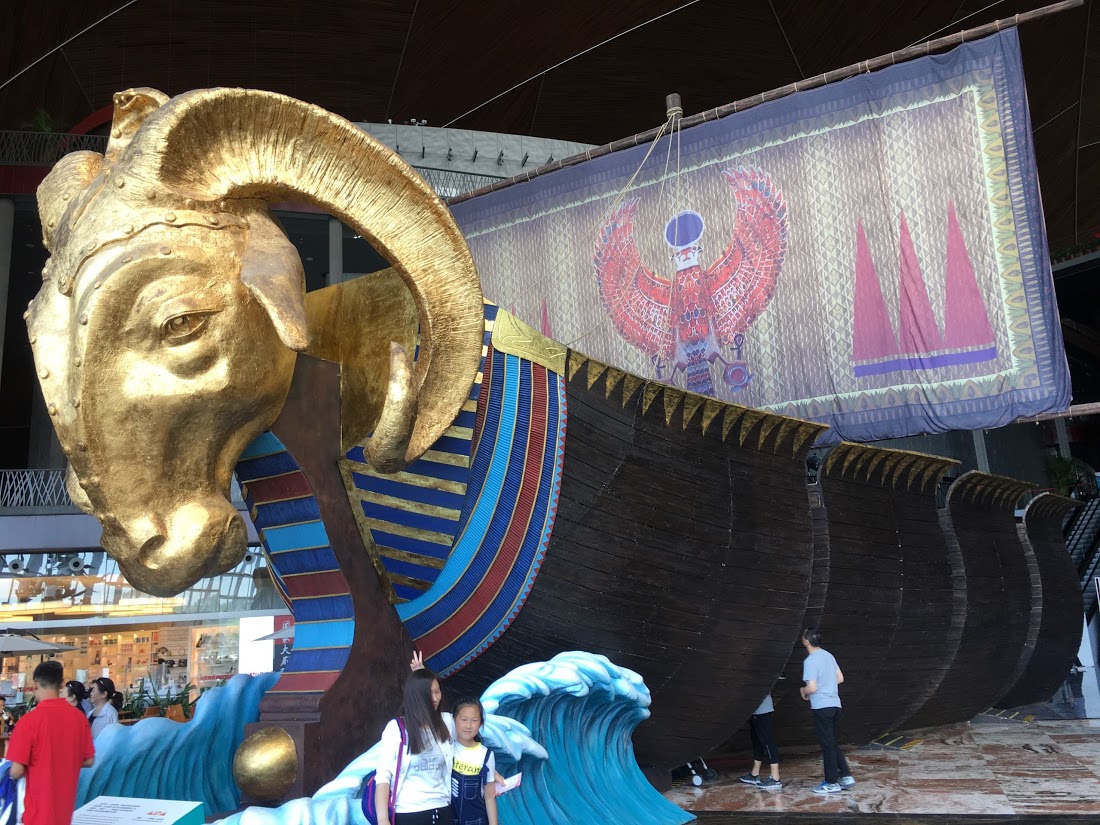


Inside the hall, the acoustics are amazing.


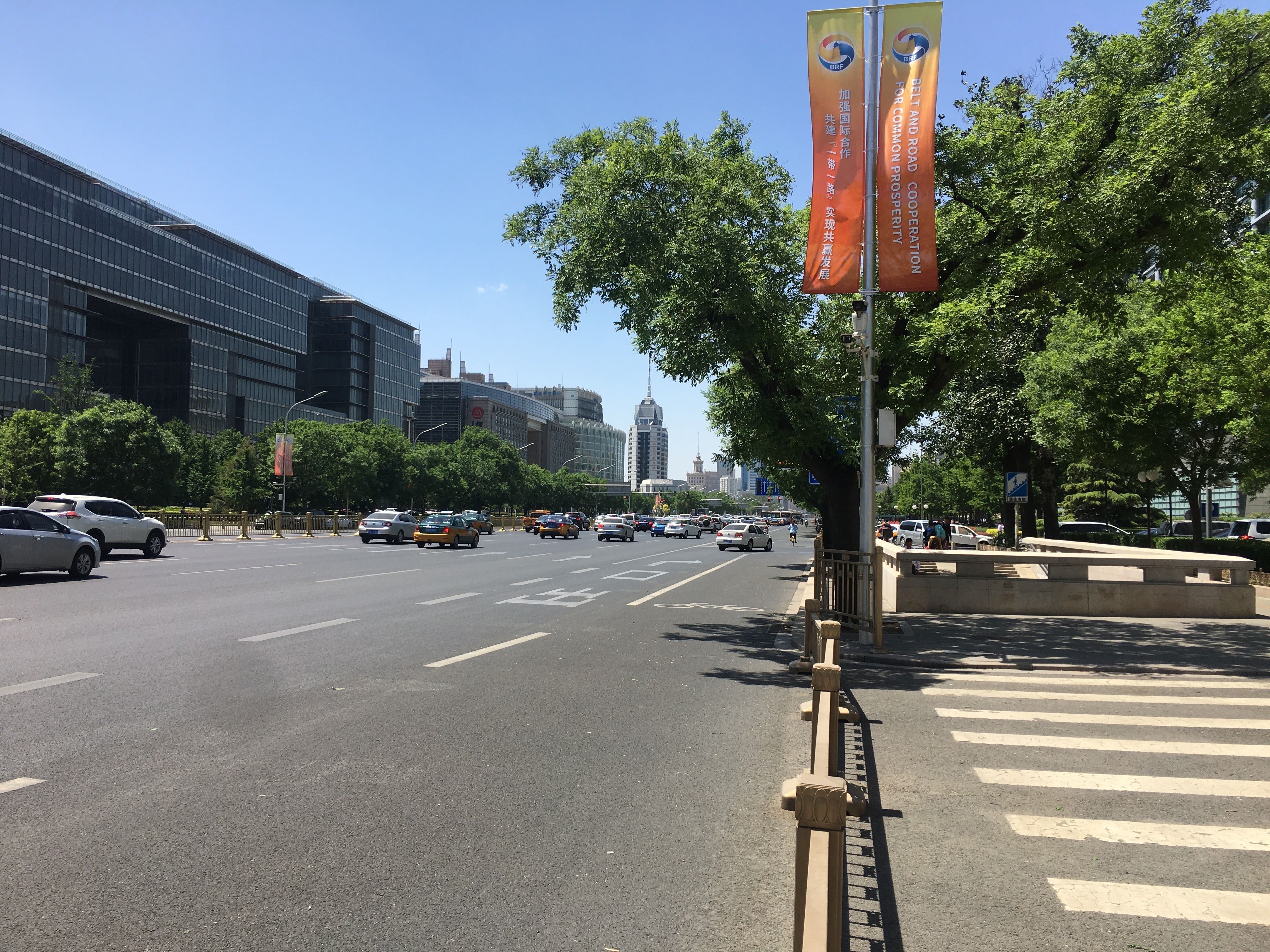
I continued west on Changan street, and almost all the buildings are new, (since 1987) but uninspiring. The Bank of China, Telecommunications, Aviation, all massive structures line the street. 
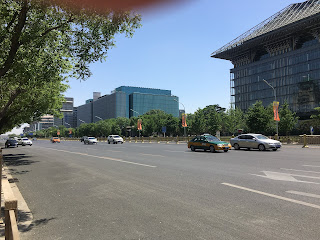


I passed Xidan, where Chang’An becomes Fuxingmen, and then I came to the Minzu Hotel, which has not changed, at least on the outside.
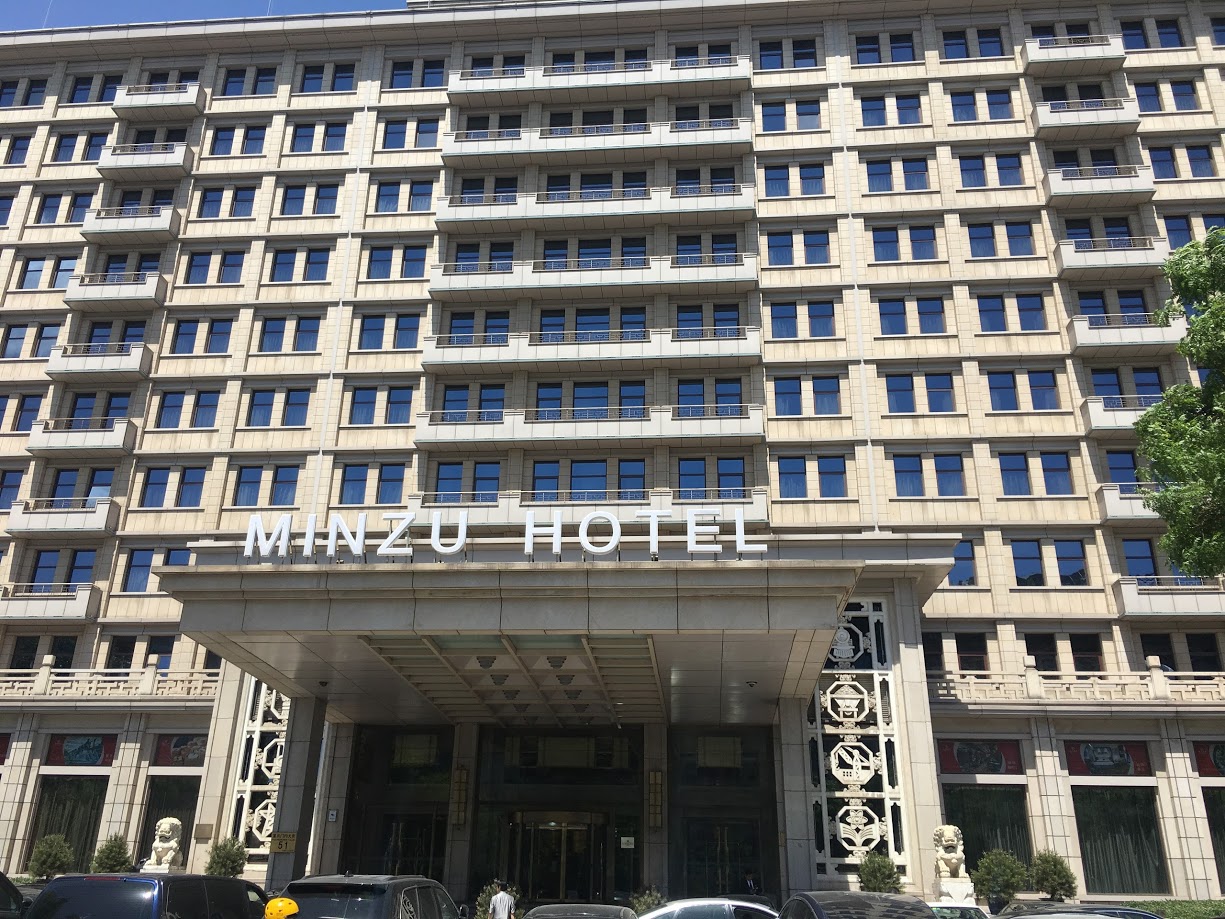


I worked for a few months in an office at the Minzu for Gould Medical equipment. Actually, that was where I began to learn about computers and software, which became my profession later. Just passed that I turned north on and begin my ‘dead reckoning’ through the mixed residential/business neighborhoods navigating to Haidian.

When I finally arrived at the Friendship Hotel, I parked the bike and locked it, so the next bike renter could use it.  I would make it back to my hotel via public transportation.

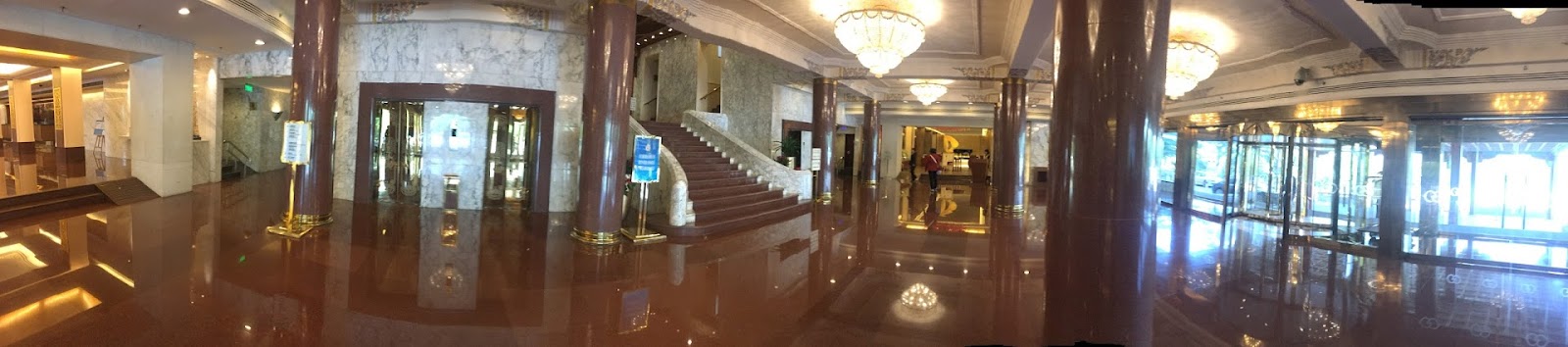
The exterior of the Friendship was unchanged, and the interior was not a big disappointment.
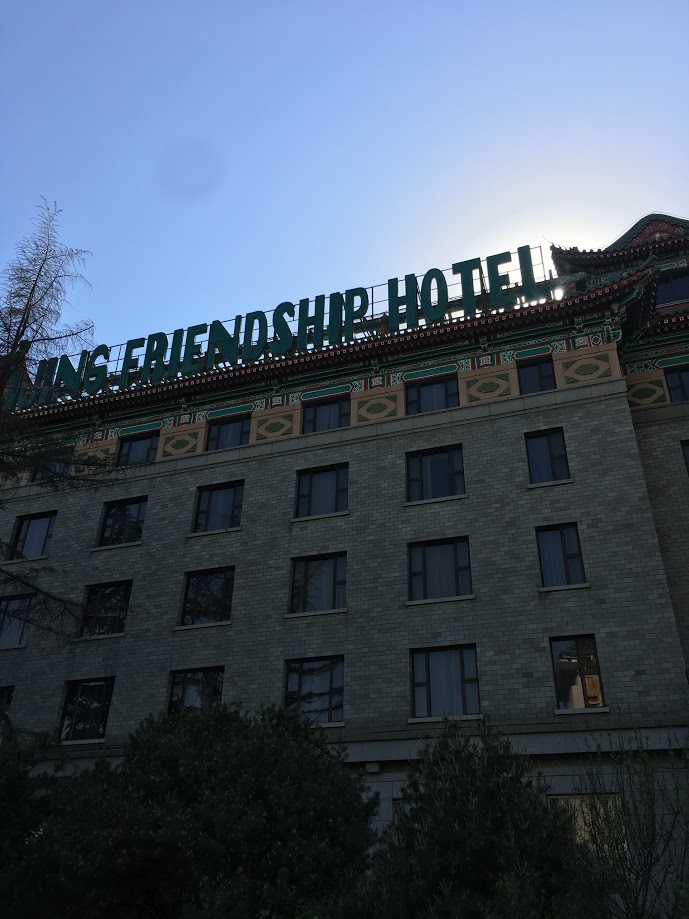


It was garish in the old way Chinese public buildings sometimes are. A highly polished brown marble lobby lead off to a restaurant to the right, (which used to be a bar where the servers were young women in long heavy army coats that might have been surplus from the Korean War). Now the staff had an uninspiring but professional appearance. The young guy in charge listened in awe as I described how used to be in the 1980s. The rooftop bar had been gone a long time, probably since the 90s. He had no memory of it.

I remembered it, but alas have no pictures. It was gritty, stained wood mostly, with a very insolent staff, but with at least a sense of humor. Here it is now.


I went outside and went over to the south end, where the swimming pool used to be, now a TGI Fridays. The pool had been an exclusive place for foreigners and was never too crowded. In the summer it was always a place where you could find some company, mostly Warsaw Pact types, but still, it was a fun place to drink, sit in the sun and take a dip when you got too hot. I realize now what a real bit of luxury it was for us poorly paid English teachers and the shabby non-Western diplomatic corp, many of whom were housed in the Friendship Hotel compound.

I sat down at the TGI Friday’s bar and had a beer and talked to the bartender. I sometimes get loquacious when I drink, and it doesn’t take much. I had an empty stomach and was extremely thirsty from my long hot bike ride. And older American man sat a few stools away, and I told him some tales of the old days. He said he came to stay at the Friendship every year for the last five years to teach a seminar on legal theory and saw himself as a bit of a China-hand. But listening to me rattle on in Chinese with the bartender put him at a disadvantage. I told him I wrote a novel about my experiences and gave him the web address to buy it.

Farewell the Dragon

I walked over to my old school, about a mile away via a lane that wasn't there thirty years ago. On my way, I had some lunch at a Yunnan luncheonette and ate some steamed chicken and spicy noodles and drank another half liter of beer. When I got the old campus, I found it very hard to recognize. The geography of the place was firmly embedded in my head, but all of the administration buildings and dorms were rebuilt and configured differently than they had been. The main administration building was now an eight story red brick building. I went in took the elevator up to the floor that said “English Language Training” and just started wandering around looking in offices, and introducing myself, asking about old colleagues. It came to nothing.
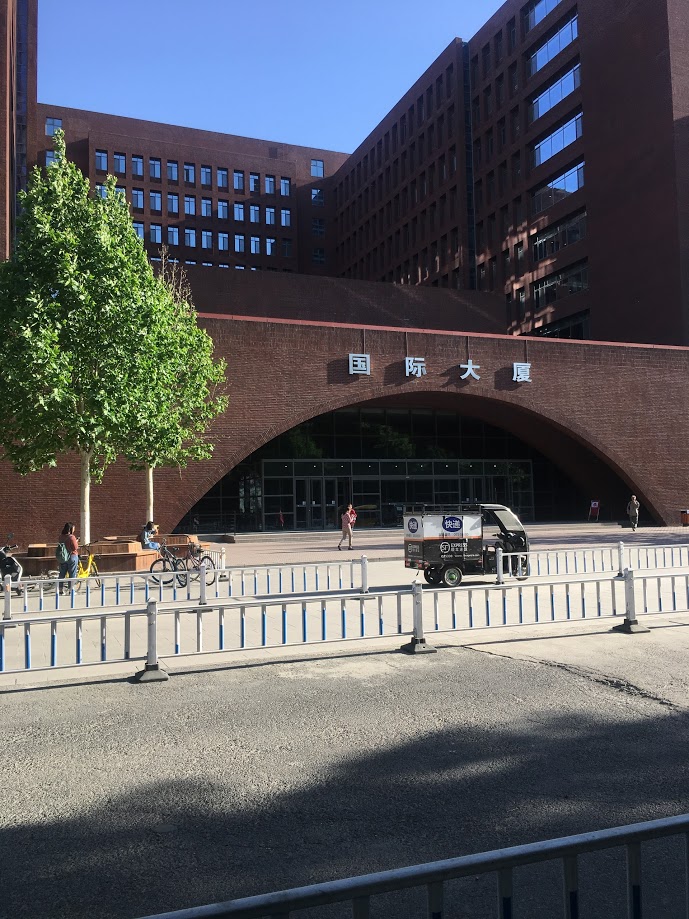


I went over to what is now called “the retirement buildings” in the back of the campus, where I used to live. Most of these buildings were constructed in about 1958-59, designed by Soviet engineers in the days before the great thaw in Sino-Soviet relations.
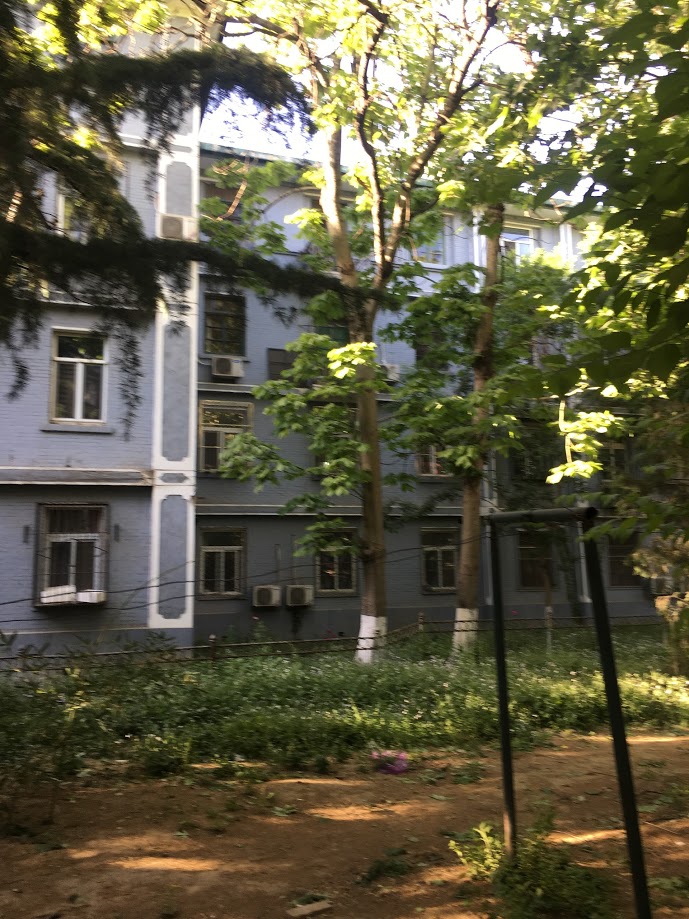


The old neighborhood had not changed, much. I wandered around and talked to old people sitting on stools in splotches of sunshine, who were more than happy to reminisce with me about the old days. I asked about my old colleagues, and it was what you would expect after thirty years. Most of the people I chatted with had been there since before and after the Cultural Revolution, when most of them had been forced to the countryside. None remembered me, exactly, a lot of foreigners had come and gone through the years. I asked about professors I remembered and they remembered one or two of my old colleagues. Some of my old friends had died during that time, some had moved away to live with families in other parts of the country, others were not remembered.

One of my neighbors there had been David Crook. Crook was an English Communist who fought with the International Brigade during the Spanish Civil War and raised his family on this campus. I saw him occasionally but never socialized with him.  He spent five years in prison during the Cultural Revolution but still stayed on in China after his release, continuing to teach and research until his death some years back.  He is most famous for informing on Eric Blair (George Orwell) in Spain to the Russian faction, from which Orwell barely escaped with his life. (Hundreds of not-quite-leftist-enough volunteers were being shot then).

David Crook and George Orwell

A young woman I talked to wanted me to meet her neighbor, a foreigner, English, who had been living in the building next to my old address, (Beilou) for the last five or six years, but we discovered he was on holiday somewhere. I spent about two hours talking to people who lived next to him. One old lady had lived there through it all but didn’t remember me, nor I her, but who wanted to talk and gave me a concise history of the campus, leaving out anything related to political events of course. The school was probably second in importance to Beida, Beijing University, in terms of historical significance.

The weather was nice that day, and lots of people were outside, doing Qigong, or repairing furniture in the various courtyards. Where bicycles used to be parked were now motorcycles.

Below is the entrance to our old apartment - it hasn’t changed much.
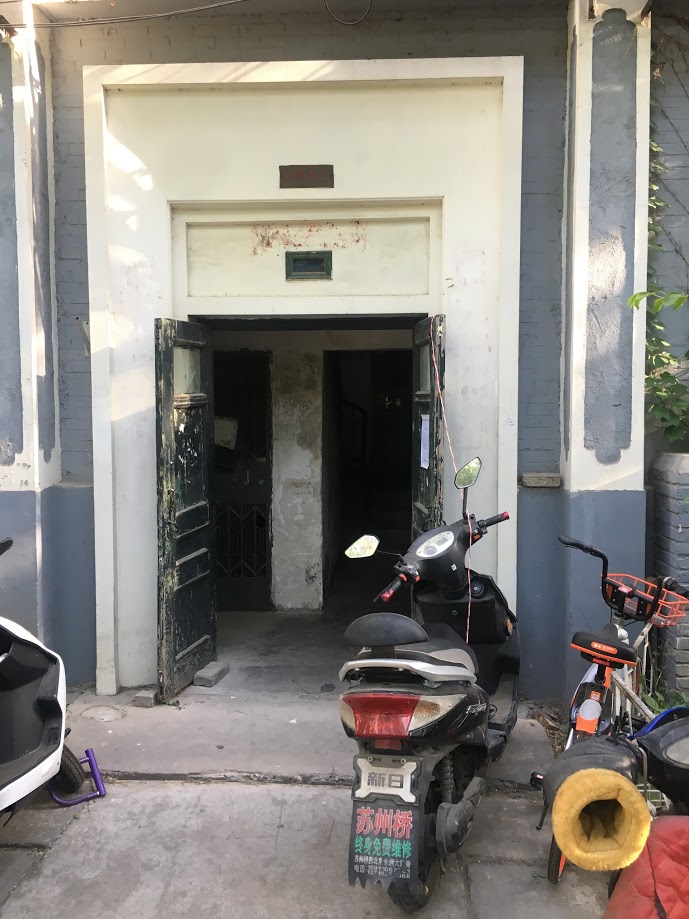


It was much greener than I remembered. Trees had been planted and some had grown very tall. There was thick grass in the courtyards. It had been dusty and bare during my time.

I sucked up as much of the atmosphere as I could, but it was getting on in the day so I took a bus down to Gongzhufen, the Princess’ Tomb. It was an old story from the 18th century when a young peasant girl was noticed by the emperor, (traveling in disguise) who promised to help her. So later, during a famine, she came to Beijing with the token he had given her but is despised by the court because she was a peasant. She died tragically, and her family buried her with the honor the Palace denied her at Gongzhufen which was well outside the city at the time. Even though she was a peasant, the locals continued to refer to her grave as belonging to the "Princess". In the 80s Gongzhufen was a simple traffic circle but now is a major four-leaf clover intersection.   There I caught the subway back to Wangfujing, where I planned to eat street food at the market there.

Which brings me to my main story. It was twilight and I decided to walk over to the food courts on the Dashamao hutong off of Wangfujing. As I walked, two women approached me and began a cheerful conversation in English with me. The women were both middle-aged, over forty, dressed in clothes that were remarkable only by their undistinguished quality. Not too poor, but certainly nothing at all stylish even in an ironic sense. One of them was quite heavy, and the other could have been attractive with the slightest attention to her appearance, which she did not seem to care about. They said they were middle school teachers, looking to practice their English.

This had happened to me countless times. In the old days, I had a queue of excuses that I used to avoid being a street corner English teacher. But there was a something about their demeanor and the smokey languid feeling of the approaching dusk, and my mood in general that relaxed me and I let them tag along, in fact even bought them a snack while I grabbed a lamb shish kabob and some dumplings. We sat at an empty table and we talked about nothing much. They both spoke well, with excellent (American) pronunciation within their limited vocabularies.

They suggested we go over to a teahouse nearby. We walked to the end of the street food alley and turned right and came to a house that seemed like a holdout from the past, perhaps slated to be torn down soon some urban plan. The wooden steps seemed creaky and steep. We went in and were greeted by a very pretty, California-casually dressed young woman with a pony-tail who led us to a table in the back. We were the only customers.

The three of us talked about teaching. I expounded a little about how I taught in the 1980s, and they talked about their classes, (it seemed they taught in schools outside Beijing), and the difficulties with a shortage of books, and other materials. I was interested in the class disparity, which I knew existed - like everywhere, the rich in China make sure their kids get better educations. But they did not want to talk about that. We kept talking about banalities.

The tea finally came. The pretty hostess with the pony-tail brought two small white porcelain teapots and poured. There was some discussion of the different kinds tea she was serving and how it was very exclusive, but my tea palate is very uneducated, I can tell black from green tea and that is about it. She also brought some plain thin crackers.

After about twenty minutes, I felt I had done my duty and wanted to get back to my hotel and I made noises that I was about to leave. The heavier woman, ( they never told them to me their names) said that since I was a rich American, that paying for the tea of poor Chinese was easy for me. It was a strange thing to say, I thought. I figured the bill might come to as much as $10 US dollar in RMB.

But it came to about $80.

A large young man came out of the kitchen to watch the transaction.

“You are cheating me,” I said.

No, no, the pretty young Malibu-styled hostess said, it was special tea, very rare and fragrant.

I paid it with my big bank visa card, thinking I could go home and cancel the transaction back at the hotel. I left quickly, loudly cursing them all, but otherwise not wanting to make a bad situation worse.

I was quite angry, because, I didn't like being a chump. I walked back to my hotel, about a mile, and thought about it. The ruse had been elaborate. The women, being of unremarkable appearance and also being pretty bright as English speakers did put me off my usual radar that I was being scammed. Sex had never reared its ugly head which of course would have set off alarms. It had seemed quite innocent. The amount, $80 was right on the border of being extortion, but not quite.

 I started going through the various permutations that could play out and decided heck with it. Eighty bucks - I could afford it. Lesson learned.  I got ripped off, but it wasn't the worst thing that could happen, for sure.
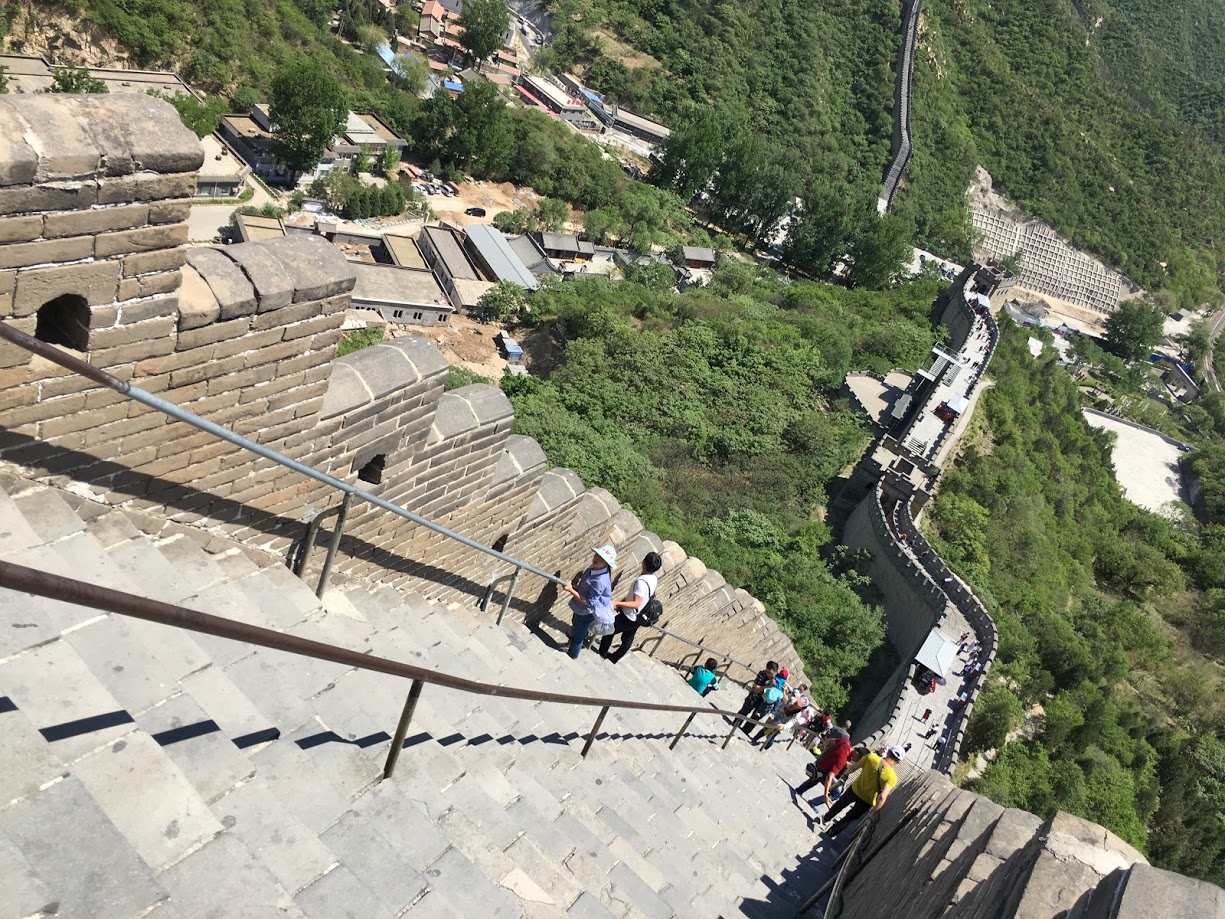


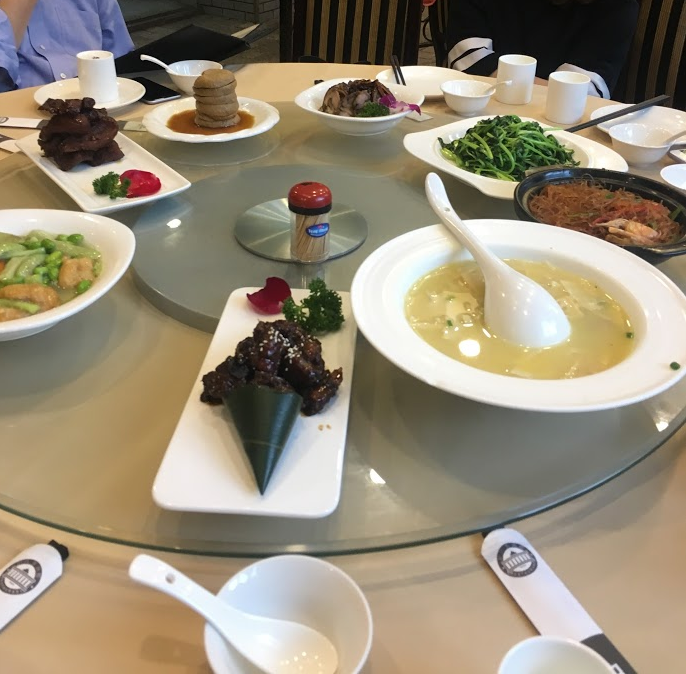
The next day I went to the Great Wall, and had dinner with some friends.


I still had a couple of days, and I spent it walking - around the Olympic village, and the Bird’s Nest stadium, and up and around Jingshan, the Hill that overlooks the Forbidden City from the back. The Mongols had slave labor build Jingshan out of the muck from the adjoining artificial lake (Beihai), and later the last Ming Emperor hanged himself on the hill from a tree as Li Zicheng's rebels approached.  Six weeks after that, those rebels would be overthrown by the Manchu invaders who would establish the Qing Dynasty.


The following day I went back to Haidian to see Yuanmingyuan, which now was surrounded by a fence and appeared to in the process of being developed for tourism. Back in the 1980s it was just unfenced open fields, overgrown and gone to seed, with some stone ruins around a lake.  It had been left pretty much as the French and British had left it in the 1860s,  burned and destroyed. It had been one of the wonders of the world, the old Summer Palace, or the Gardens of Eternal Brightness, the architectural apex of the middle Qing dynasty.

The next morning I was back downtown, near the “scene of the crime” when the fat one approached me. I saw her coming and wondered - could she be coming to apologize and even offer to get my money back - this actually flashed through my mind.

“Hello, would you like to come and have some tea and some talk?”

She didn’t even recognize me. I was stunned.

“I know you,” I shouted at her, in Chinese. “You cheated me!”

She looked again at my face and the horror of her mistake suddenly dawned her. She turned around and started to waddle away very quickly. “I don’t know you! I don’t know you!”

I suddenly realized I was angry - why? Well for one thing, at the fact that I appeared to be such an easy target that she could approach me again and not have a clue she had stung me two days previously. The fact that there was nothing special about me, probably pissed me off the most, as well as the fact that this was a regular scam, an ongoing industry ripping off Western tourists, not just a one-off.  My kind and gentle appearance marked me as a patsy.

I decided I wanted my money back.

As I said, cops are easy to find on the streets of Beijing. I found one and explained what happened and that I wanted to make an official report. He called someone and told me to wait. Soon a minivan with official government logos pulled up. I got in the back seat. There were two cops in the front.

One of the cops, sitting in the front passenger seat was really funny. Neither of them could speak any English, so I really had to pull out all the stops to get them to understand what had happened. I told the story of meeting the two women, eating at the food court and going up to the 2nd story teahouse.

“So, two old ladies frighten you and made you give them money?”

It was all for laughs. They both had incredible Beijing accents, very thick with an ‘r’ added to the end of many words. The word “Men” as in "door" ( 门) becomes “mur”. Or the traffic circle - gongzhufen - would be gongzhufur.  Beijing provides the standard pronunciation for China, but real Beijing dialect is far from what you hear from the CCTV newsreaders. It is “street” and authentic.

Anyway, we got to the coffee bar. It looked different in the daylight, not nearly as ominous. Although now I did see the sign advertising it as a "spa - massage" place.
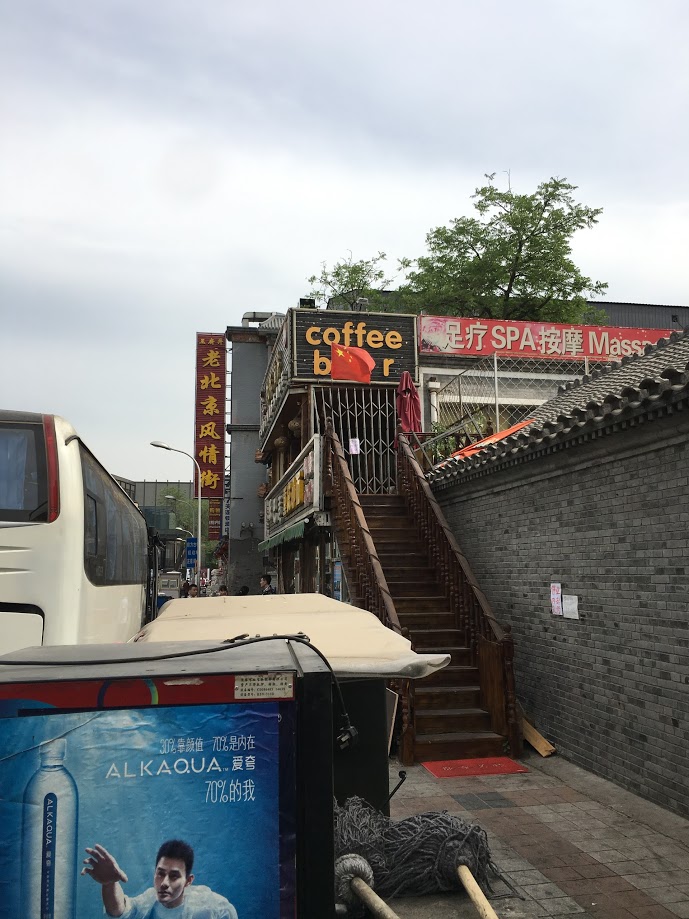


My Cop friend climbed up the steps to investigate. They had left a note.
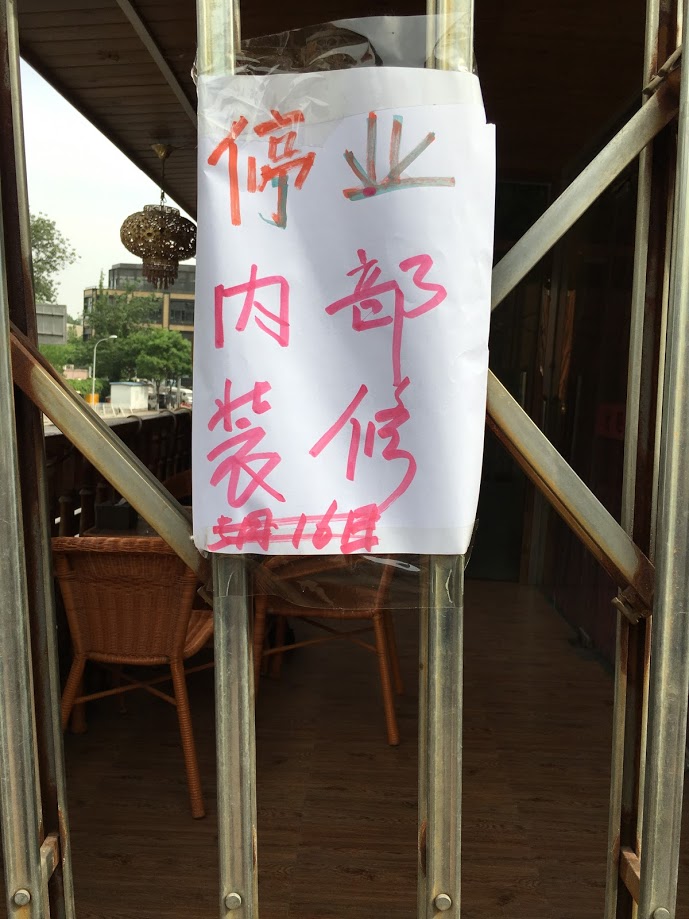


The note says, “Business stopped. The inside is being repaired”

We drove to the nearby police station. The front desk was just inside the front door. No security cage or anything like you might expect, it was all right there, available to mayhem if any suspect was so inclined. Along the outside walls were hard benches. They told me to sit while they went and got their supervisors.

It took about twenty minutes, (I had another dinner engagement with friends at six and it was almost 4 P.M.) Finally, they came out with a young policewoman dressed in a very sharp, snug fitting blue uniform. She had on a man’s cop hat with a brim, and her long dark hair was piled up into it so her hat sat very jauntily on her head. She smiled and spoke excellent English and was to take my statement.

It was a very friendly interview, but serious too. We went over the descriptions of everyone, and timeline that things happened. Why had I gone with them to the teahouse? What was I expecting? Why hadn’t I reported the incident right away but waited two days? Can you remember if they wore jewelry? I answered absolutely truthfully at each point and she carefully wrote out everything in Chinese. It took about a ½ hour. She asked me if they could find the offenders and get my money back would I be satisfied? Yes, I said, but then explained if they couldn’t find them within the next 20 minutes or so I would have to leave because of my dinner engagement. She understood completely. She then said she was very happy that I had reported this scam because these criminals give China a bad name. She had me read and sign the statement.

But then I heard a commotion just outside the door. My two cop friends who I had driven with brought in a very nervous middle-aged man, who I had never seen before, and who was grasping a wad of cash. My charming interrogator told me that it was the man who owned the “Coffee Bar”. He came over and everyone in the station surrounded us and he handed me over the equivalent of $75, apologizing and pleading saying he had no more but would go to the bank and get it if I required. I happily accepted it, because the tea was worth at least $5. I shook his hand again and everyone in the room was beaming. My cop friend with the heavy Beijing accent leaned over to me and said, “Don’t worry. He won’t do it again!”

So I walked out and caught the subway back to my hotel to get ready for my dinner. I told my Chinese friends at dinner what had happened and that I felt bad because I could have afforded to lose the $80 and it was probably a lot of trouble for the owner and his confederates. No, no my friends said. We need to clean the crooks out of Beijing. I had done a good thing.

Of course, it is amazing when you think about what would have happened if a Chinese guy had reported a similar thing in the US. It is doubtful it could have been solved so quickly and with so little angst. But when my cop friend said “Don’t worry, he won’t do it again”, that did give me pause as to what they would do to ensure he would not repeat the crime.


Farewell the Dragon

Tuesday, March 20, 2018

Friendship and Politics in the Age of XiTrumPutin

Friendship means something more in China than in the west. It is a different experience, a delight in its sincerity and intensity but also a responsibility. It is hard to explain to a westerner who has never come under its spell. It doesn’t require constant maintenance, but when it is renewed, even after years of separation, it is understood that it is not just a lifetime commitment, but one that can transcend generations if properly observed. WeChat helps maintain these relationships, but the recent tightening of political control coming out of the 13th National People's Congress seems to be putting a damper on what we can say. You can just feel it, even though nothing is explicitly expressed. I know I will not lose touch with my friends anymore, but it feels like we are descending into another period of political estrangement, and even though our "WeChats" are innocuous and bland from a stranger's perspective, there is an undercurrent that wasn't there last year.
The major difficulty with maintaining friends with Chinese people in times like these is the fear that my publicly proclaimed opinions about, and strong disapproval of the dictatorial actions of the CCP will somehow taint my Chinese friends, cause some loss of preferment or other subtle punishment that can affect them. They claim when you see them not to be bothered by it, but just the same I try to be careful when chatting, even though if looked at objectively what I say is not related to them in the least. I know a bit about Chinese history, (with 3,000 years of continuous historical records - who can say they more know than “a bit”?) and I know it is presumptuous to judge that kind of continuity too hastily, but there is a ying and yang to that history, a cycle (天降大任) related to mandate of heaven, (天命) that China can't seem to escape. The curbs on political freedom in China deeply sadden me, and the harsh repression of those who break out of silence in China infuriates me. I hear the voices of those inside and outside China risking everything in their call for change. And I acknowledge those who say that to ignore or gloss over it, is to be complicit with it on some level.
Still - it isn’t really all that simple. I speak Chinese well enough to converse with non-English speakers on more than a superficial level, and what I heard when I was there last year was not outrage so much as resignation and a willingness to give the devil his due. I talked to strangers in restaurants, people on trains, people who helped me in ways small and large and the sum of it was - they know what is happening, they have an awareness of the repression but always put it in the larger context, the crux of which is - it is so much better now than before. Right now China is more prosperous than it has ever been. That it is freer in an economic sense cannot be denied. People can rise based on their own merits in ways that were never possible before. China is respected on the international stage and there is pride in that. This is no small thing.
It is clear to me that CCP is from an internal perspective a patriotic organization, and the majority of its pronouncements and policies are aimed at benefiting the majority of the Chinese people. It is, for the most part, rational and not driven by racist hate or even xenophobia. After our most recent election, perhaps, the CCP says, and I can not disagree, we liberals in the US need to fix things at home before we go looking for evil on the other side of the world to oppose. Besides, the last fifty years should teach us all that pressuring China on its domestic policies doesn’t work.
I can go on and justify China’s domestic policies by looking at its history and how it has reaped a lot of harm from western ideas that got warped when transferred to a Chinese context (see the underlying “Christian” ideology of the Taiping, whose revolt in the mid-19th century might have killed more people than any war in history. Or, even consider Marxism, another “Western” idea). But I have already stained myself in the eyes of some as a dupe of the Chinese Communist Party so perhaps I should just stop here. Being a cowed useful idiot is not something anyone who wants to think himself to be. I have read Ma Jin's scathing criticisms of Westerns who kowtow (磕头)to Beijing. It is very easy to understand his viewpoint.
But for me, I want to be with Zhivago, and move to the countryside with Julie Christie, and pretend none of it is happening. As I get older I find my active politics ends at the shores of the US. I feel perfectly justified at raging against the US government and everything Trump is doing, vilifying him, satirizing him, calling for his impeachment and the jailing of him, his family and henchman at the soonest moment possible. But other than shaking my head sadly at the rise of dictators elsewhere, I stay out of other countries' business.
You can make the old “What about Hitler?” argument. If I had been alive in the 30s, would I have condemned the Nazis for their racist, anti-semitic policies in the years before we knew about the Holocaust? Would I have called for boycotting everything German in those days? If the world had united and condemned them at the time, might it have had an effect? (I stare back blankly, sheepishly…acknowledging that standing against evil might really not be as complicated as I pretend.)
But contrariwise, look at Mesopotamia in the post-Bush(Jr) era. Look at what American Exceptionalism led to - maybe a million dead and a society destroyed. Many people the world over are tired of American “do-goodisms” and see us sticking our noses in other countries affairs as insulting and in the long run counterproductive to the long-term struggle of the people who actually have to live in the countries involved. I can’t see that far ahead, and history is always a surprise, so we make our choices and take our chances.
Anyway, for those of us who care about the well being and happiness of our friends to the exclusion of protesting against the government's they live under, we probably have a lot to answer for, but would in any event anyway.  


Saturday, March 17, 2018

Review of "Red Mandarin Dress" by Xiaolong Qiu


This review was originally published December 31, 2012 on Amazon.com


An old man, soon to be forced out of his old familiar Shanghai dwelling by a developer of high rising, expensive apartments finds a young woman's body, her legs askew, barefoot, without underwear, clad only in a torn red Mandarin dress, (qipao). This opening scene of the Inspector Chen crime novel 'Red Mandarin Dress', illustrates the theme of the old and new China colliding with painful consequences. The Mandarin dress, is a perfect vehicle of this clash, as it was once a symbol of elegance in the China before Mao, then a symbol of decadence, only to re-emerge in the post Deng Xiaoping era as a chic symbol of wealth and status. Qui makes the dress his serial killer's calling card and the search for the killer is a trek through 20th Century China itself.

Inspector Chen, a famous Shanghai detective, is getting pressure from his Communist party bosses to take on a political case to protect the Party from embarrassment in a real estate corruption scandal. Chen, who has translated several famous Western Detective novels into Chinese, is a lifelong amateur scholar and is finally getting serious about his hobby. He wants to avoid the dirty real estate case by trying to plead off by saying he is too busy with a literature class. A noted human rights lawyer has the party in his sights again, this time by suing a crooked real estate mogul who is pushing people out of their homes. The Party wants to bring him down. Chen's maneuvering to avoid the real estate case is a classic illustration of the social mores that dictate relationships in official China. Chen is not brought in to investigate the murder until a second one occurs with the same MO - the disheveled body, suffocated, in an identical, old style, hand-made Mandarin dress. Neither one of the bodies had evidence of sexual activity.

The politics of the Chinese police play a central role in the novel. Li, the party leader, sees everything through the lens of the pre-boom China. "Check with the neighborhood committee' he says, clearly oblivious to the fact that Shanghai life had changed - at least for the wealthy. People had their own apartments now, and were not under the thumb of the old Party ladies who controlled everyone's life with gossip and 'motherly' intrusion. The real cops barely give Li lip service while moving ahead with the case based on the reality of the evidence and their available resources. Li is of course concerned because of the public nature of the crimes, because the bodies are being left in the most populated areas of the city - right on Nanjing Rd, in the center of town. The information starved daily news papers are speculating in a way worse than anything readers of Fleet Street or the NY Daily News could even conceive. Sex and Murder in a town where politics can't be seriously discussed are big stories.

There are a host of secondary characters in the novel - Chen's colleagues Liao and Yu,Yu's wife, Little Zhou, the department driver and Hong a pretty young police woman ho is assigned to the case. All are devoted to Chen and help him by doing whatever research etc that he needs. Inspector Chen also has a host of other allies, business men and restaurant owners who vie for his favor. He even has a young woman, White Cloud, whose salary is paid by Gu, who wants Chen to quit and work with him in his business. White Cloud would be anything Chen wants, but her main tasks is checking up on Chen's mother, who of course wants him to marry.

There are others too - the literature professor he studies with and his daughter, and all of the people Chen meets as he investigates the crime. Beijing (the Central Government, hated by Shanghai) continues to pressure him on the first case too, so he investigates the human rights lawyer who is suing the real estate crook.

Chen only begins to devote himself to the case when someone close to him is killed by the serial killer and we start diving into the real story of the Red Mandarin Dress. Chen is a weak man in the Western sense of the word. He is constitutionally the opposite of the typical American hard-boiled detective. He can't handle coffee much less booze. He has a serious nervous condition and he has to steel himself constantly to push on to solve the case. Chen is constantly moving in his thoughts from the past to the present and seemingly gets side-track on the most obscure points of literature. Because Chinese people have a deep respect for teachers and scholars his foibles are tolerated. Even Li the Party leader leaves him alone. As much as money drives this new China, a man like Chen retains real power because deep down, the Chinese really don't respect 'Big Buck'  guys even though they fear them. Confucius remains the model man.

The case has roots in the Cultural Revolution, which deeply scarred China and in large part, this novel is about that scarring. Chinese policy, after Cultural Revolution finally ended in 1979, was about forgetting. Too many were guilty for a full accounting. If you think of how the Vietnam War still affects the US, with division, mistrust and anger, and multiply it by ten thousand - even that, I think, would not come close to the affect that that period of discord had on China. The novel intersects the Cultural Revolution with the modern changing Chinese society in a way that is startling and yet is restrained and understated in the 'Chinese manner'.

Westerners who come to this book thinking of the other detectives whose adventures have been like Chandler's Phillp Marlowe or Hammett's Sam Spade or any of the detectives of Elmore Leonard might be frustrated by this novel. While all of these authors have their digressions - think of the long section about the history of the Maltese Falcon that Dashiell Hammett invented - still their digressions are 'hard links' to the main story. Sometimes Qui's digressions are 'soft links' - they kind of sort of fit into the big puzzle, but not directly. The novel is a bit of a scholarly romp though the history of Chinese poetry, a deconstruction of ancient stories that are told again and again, each time changing, the history of Chinese clothing - and the details of the organizational structure of the Cultural Revolution and its affect on real people. Another words, its not a detective potboiler. If you want to know who done it, you have to wait, (even though it is easy to guess about 2/3 of the way through)and if the scholarly romp doesn't interest you, then it might not be your book.

The murderer, when he is finally found, will not be an unsympathetic character. You could say that Hannibal Lector had some good qualities, but this goes way beyond that. So, once again, it is not a book that fits between the lines normally found in the genre.

Novel's like this - hybrids - are difficult to judge and grade. In math - X + = -. So if it is a good scholarly romp but a bad pot boiler - well that is a minus. I liked it - and give it 4 stars, but it has to find the right audience. I think anyone who knows China and loves it for what it is will appreciate it. If you are new to the Middle Kingdom - then be ready to adjust your expectations about what a detective novel is about.

Tuesday, March 13, 2018

Mother doesn't like me - Blues from the Streets of Xian

Last spring on the Streets of Xian I heard two musicians who were within a half mile of each other.  An erhu player on a freeway overpass that in 1985 was a little not-too-busy intersection.


In my novel Farewell the Dragon, my main character encounters an old, poor erhu player, about 1/4 mile from where this fellow was playing.  My erhu player would eventually become a sensation in pre-internet China - but that was just fiction.

"The next morning when the blind erhu player arrived at Xiao Zhai, I broke away from my breakfast of tea and lamb and barbecued pork on unleavened bread, and cold noodles with vinegar and cheap white liquor and found a spot to sit. He was dressed like a monk, except for his porkpie hat and fifty cent-piece sized dark round glasses. He alternated from very sad to madcap delight, matching the mood of the piece he played...I was put in a trance by the music, it was something so different from my past reveries that I was almost able to shed my so-called objective view of life.  There really is a Dao (道)...and the erhu music rode on the currents of the Dao, pulling me in..."

Click links below 

Erhu player in Xiao Zhai, Xian China

妈妈不喜欢我

And just down the street - a kind of Chinese blues - My mother doesn't love me...

Xian-blues


Saturday, March 3, 2018

Introducing the Second Edition of Farewell the Dragon

The Second edition is ready! The book is available on Amazon and other bookstore outlets.  Here is a bit of an introduction to the novel.

See what others are saying here.

Farewell the Dragon Reviews

Buy it here. (New lower price!)

Farewell the Dragon


Farewell the Dragon?


What is this novel, Farewell the Dragon (FTD) about and why should you read it?

Now in 2017, it is historical fiction, a slice of life from three decades ago, in a place and time unlike any we are likely to see again.

The Cold War was on its last legs, and just before the novel begins, Reagan had asked Gorbachev to "tear down this wall!"

China had just woken from the Cultural Revolution, and its scars are still fresh, but the anticipation big change was everywhere.

The events of Tiananmen in June of 1989 were still a couple of years away, but the clues to its genesis littered the scene. China was at the apex of Deng Xiaoping’s 改革開放; Gǎigé kāifàng; literally: "reform and opening-up" policies. Westerners with liberal arts educations were welcomed to teach with almost complete freedom, to travel, to socialize and even, if they were careful and used discretion, to love.

China was, technologically, (compared to the West) still in the 1930s. At the university where I worked, in Beijing, there was one telephone on campus, and the easiest and fastest way to quickly communicate with the outside was to send a telegram. There was one shower house, that nearly everyone had to use, for the entire faculty/foreign student side of the campus. Mass media consisted of one or two TV stations that constantly reran shots of factories, that appeared to have just been cleaned, with neatly filled bins of indeterminate raw material being dumped into recently polished cauldrons, all managed by nervous technicians dressed like Chicago meat cutters expecting a visit from the FDA inspectors. The voice over, a monotone staccato, probably spoken by unsmiling young women in clear-framed glasses and loose-fitting dull blue pants and blouse, praised local officials for raising production for the tenth year in a row. Then, in mid-sentence, the video would jerk to a painfully awkward ribbon cutting ceremony, where portly middle-aged men in Mao jackets applauded each other...

The first thing I noticed living with authoritarian propaganda is that the more governments lie and oppress free expression,  the more people will value the truth, any truth. As a foreign teacher, I was exempt from the petty Party induced paranoia that my Chinese students and colleagues had to endure, and was greeted with universal warmth and goodwill. The freedom I had, to teach what I wanted and spend my free time as I wished was the dream of everyone around me, colleagues, students, and the campus workers. My existence was a model, a thumb in the eye of the party that had decided to endure for the sake of Deng Xiaoping's grand policy statements.  It was a huge responsibility, and I squandered it with proper elan and panache to the delight of the audience that was almost always cheering. This open-door gilded cage I lived and worked in had the effect of burning out the western cynicism that I had carried around with me before coming to China. For the first time in my life, I felt like everything I did really mattered.

Thinking back, I realized I had never been so close to the people around me, especially now when we can console ourselves with fake social media-driven lives. It is ironic that enforced isolation opens people up. The thrill was amplified by China itself because the incredible physical change to China, the make-over of the cities with endless skyscrapers of recent years had not begun. In the 80s, Beijing was still, for the most part, a flat, one or two storey city of alleyways, or "hutongs". But the psychological change was already rolling through the city like a slow moving tsunami. Clothing styles were morphing overnight. Mao jackets and blue work jackets were changed to blouses, skirts, and jeans. Arrogant attitudes and sexually tinged postures were being tried out, basement dance clubs started appearing in the outlying reaches of the city, reverberating with nasty metal-rock from cheap Taiwan-made boomboxes. Secret clubs for foreign businessmen and their special Chinese friends were rumored to be opened at certain hours on certain days. The feeling was electric and affected everyone, from students to workers, and the Party itself. Foreigners were becoming more numerous and you could see the effect it was having on the Chinese people.  But the oppression of the Cultural Revolution still held sway, psychologically if not in fact.

The FTD story takes place between August and October 1987, primarily in the university section of Beijing, in the northwest corner of the city. The main character doesn’t really want to leave China but circumstances are making it increasingly inevitable. Nathan Schuett, a former liberal American Democratic party political operator in his mid-thirties, has put himself into a fix by quitting his teaching job before securing the next one as a software businessman. Worse he has allowed his romantic life to become too complicated. 

But when he finds the nearly naked bodies of two university colleagues, both shot, things really begin to spin out of control. A West German woman and Hungarian man who may or may not have been romantically linked lay dead in her apartment, where Nate looks briefly for clues to a crime that no one seems to want to solve.

Nate is a man of his generation, a man who understands women’s liberation to mean sexual liberation for himself. Thirty years previously, in the 1950s, and thirty years later, (now), he would be seen for different reasons, as a disgusting philanderer. But the eighties, the disco-cocaine years before AIDs, was the high watermark in male-centric promiscuity. As Rodney Dangerfield put it at the end of Caddie Shack. "We're all going get laid!"

The double standard still applied though. He suspects that his American girlfriend has returned to the US in order to have a tryst with her former beau, and he intends to use the time apart to get his own. The authorial inspiration for his outraged jealous lust was partially inspired by Sir Harry Flashman, a bounding 19th Century Englishman, made famous in George McDonald Fraser’s Flashman novels. Flashman sees any sexual opportunity in the same the way that a Bedouin crossing the desert sees an oasis. Flashman, who also had a romantic adventure in China in one of the novels, (see “Flashman and the Dragon”), was the hilarious fictional epitome of “white Privilege”, and Nate was consciously meant to be his fictional descendant.

The other literary inspiration for FTD was Victor Selgalen’s novel “Rene Leys”, a much under-appreciated tale of the last days of the Qing Empire, the story of a young Belgian man who comes and goes, in and out of the inner chambers of the Forbidden City.


Nate is an English teacher, but also an aspiring business man.  He was a seemingly reasonable and obliquely patriotic, if mildly left-wing American, surrounded mostly by students and officials on sabbatical from the Soviet Empire. By all accounts, Nate was a model teacher at the Beijing Foreign Language school. He can get by in the Chinese language but is no scholar. After finding the bodies, he tells his story to a couple of Beijing cops investigating the circumstances surrounding the deaths of the two foreigners. On the surface, it appears like a murder-suicide, or possibly a double suicide. But for some reason, Nate knows it is more complicated than that.

When not being interrogated, there are tantalizing anecdotes told over drinks at the Friendship Hotel bar to go with the endless gossiping about amorous escapades, bizarre encounters at an illegal Beijing Bordello, forbidden East/West love, as well as a cameo or two by some famous personalities of the era.

For Nate, China is a self-imposed exile from Reagan's America. Now, in January 2017, we are entering a new era that has echoes of the 1980s. Back then, a reactionary old white man with huge gaps in his apparent knowledge had been elected President, and he threatened to undo much of the liberal fabric of the country. During the 80s, the income gap had soared, labor unions were being decimated, death squads were supported at the edges of the American Empire and the rich and powerful were made more so. For those that don’t remember the 80’s, well, it appears we are getting a chance to relive those years (in Marxist terminology, the sequence occurred first as a tragedy, and now seemingly somewhat farcically). Maybe "Farewell the Dragon" will inspire more self-imposed exiles, which in the long run, will only bring the world closer together. Remember Dante wrote the Divine Comedy as an exile.