Barckwords

Barckwords
Click logo above to see more about Barckmann's fiction

Sunday, June 5, 2016

All She Ever Wanted by T.L Cooper

All She Ever Wanted

By T.L. Cooper


All She Ever Wanted


I like fiction with a plot that moves quickly, spiky dialogue, humor, characters who don't take themselves too seriously. I really like when they make me laugh a bit, whether it is self-depreciating, or even a bit cruel. All She Ever Wanted (ASEW) is not on my usual literary menu. For me, ASEW was almost a visit to a bizarro Shang-Gri-La world, where everyone speaks earnestly about mundane things, Southern things, in serious fully formed sentences from which no satirical irony can be detected in the least. It is not about the deep South, but the Border South, you can tell because the Border South is - well on the border - not the heart of Faulkner's darkness, but Kentucky Horse Country. It is page after page of descriptions of the paint on the walls, the color of the carpets, the plait on the dresses, the heels on the shoes. But unpleasantries between people are avoided like moldy leftovers. The novel was outside my usual reading comfort zone, but ultimately, and oddly, if I may say, it was satisfying. It is without question the most blatant work of 'women's fiction' I have ever read. I needed to read it. I think it gave me insight into the 'inner workings' of the women I have known and continue to know. Observing my reaction to it was a therapeutic exercise. It gave me insight into my own world view, of its blindspots, preconceptions, and prejudices.
 
All She Ever Wanted is a slow moving, Southern story about a self-involved, tightly wrapped, spoiled woman, who achieves worldly success at the price of – well - everything that is important in life, such as love and fun. Victoria Caldwell is the product of an upper class, horsey, up-tight family, where appearances really count, and where the exterior social trappings - clothes, furniture, hairstyles, - are everything. The novel begins with Victoria musing about her past and we are taken back to her college years. She is date-raped by a frat boy, an event which casts a long shadow on her future romantic life. Then to make it much worse, she gets no support from her sorority sisters, and so that sours her trust in women as well. College would have been dismal but for her only friend, a black man her age, Daryn, who comes from a prosperous, functional southern family.
 
Daryn is demonstrably not gay, but his relationship with Victoria has all the outward markings of a stereotypical straight woman - gay man friendship. They never get together in bed, even though Victoria’s dreams all point to that being what she really wants; but because of her entrenched southern womanhood 'thing', she can never have it. That longing is something Victoria would deny until she was blue in the face, but the evidence - her soapy bathtub daydreaming, and her constant obsessive need to be near Daryn indicates otherwise.
 
Tragic things happen, and Victoria never really breaks through. She tries to escape from her self-imposed trap that requires propriety in all things, and to truly live, but it doesn't happen-not until the very very end, which is presented as a final breakout for her but - as a reader, I have my doubts she really makes it. Throughout the 532 pages, she returns to her 'bread and butter' ways of coping –solitude, hot bubble baths, and long scenes played out in her head that always seem to justify her cold outwardness, which pushes away everyone and allows her to deny her own desires. My anger at Victoria eventually turned to pity.
 
It is a book about the modern South. There is a touch of Scarlette O'Hara in Victoria. She gets possession of her great-great grandmother's diaries which detail the end of the Civil War and Reconstruction and we read how her slave and Plantation owning family dealt with that transformation – and we see that self-pity and self-involvement is a long standing family trait.
 
I have half-southern roots myself and like Chis Rock describing why OJ murdered Nicole Simpson and Ron Goldman,  “I don't condone it – but I understand it.” By that I mean when reading about how Southerners are trapped by their own history and their devotion to backward, deluded and feudal romantic ideals and patterns of behavior, I understand it even if I reject being burdened with it. I have sat in my maternal grandmother's kitchen and eaten corn bread, home-made jam, honey-combed honey, and fresh eggs, and grits, and fatty fried ham and listened to the lyrical, half-true memories of my North Carolina kin and I felt the pull of the family, of the land and - well kinship - and depending on the day, it is as strongly imprinted on me as my New Jersey 'fooget-about-it' side. I do understand Victoria's cold refusal to surrender to her. own humanity, and her need to 'measure up' to tradition and expectations that are unrealistic and soul destroying. But I don't condone it.
 
I was angry at Victoria through most of the whole read - but that doesn't mean I disliked the book. A good book makes you grow and understand things you didn't understand before.
ASEW taught me some things or rather reflected back at me parts of humanity I tend to ignore otherwise.
 
The book is technically 
well crafted. Cooper is a fine honer of sentences and paragraphs. For the reader – it perhaps it should have been more viciously and brutally edited. But then it wouldn't have been the flowery, endless search for a perfection that can never be found.


Friday, April 29, 2016

LeCarre's "The Night Manager" and the Risks of Translating Literature to the Screen

Just saw the first episode of “The Night Manager” with Hugh Laurie and Tom Huddleston. I only finished re-reading the novel last weekend and it affected me much differently than the first time I read it, about fifteen years ago.

The story, which on screen is updated to the present, was originally set in the 90s when the book was written and published. It is about a wealthy, somewhat famous, and extremely well connected Brit, Richard Roper, played by Hugh Laurie. Think of Roper as a monstrously evil Sir Richard Branson. The rich and famous clamor to be part of his life, which appears to be a continuous traveling yacht and skiing party. He has a rotating posse, the core of which consists of well-born Sir Sandy Langborne, a philandering sot, and his beautiful but boring wife. There is also Lance Corkoran, Roper's gay factotum, who speaks all the languages required, and handles the money, as well as two or three armed guards and Roper's girlfriend Jed. 


The protagonist of the story is Jonathan Pine, a former soldier, hiding out inside his own head from the guilt of a horrible wartime atrocity. He is the night manager, standing at the desk in the five-star hotel between 10 PM. and 6 AM. handling late arrivals, emergency wire transfers, and the comforts of insomniac guests.  He also handles the occasional body that turns up in luxury suites in the wee hours.

Re-Reading a book is always an adventure in self-discovery. The novel's stucture, (which I didn't see the first time I read it) is in large part a series of short scenes, mostly glimpses into the mind of Pine, whose anger, guilt and love burn inversely to the calm exterior he exposes to the outside world. It sometimes reads almost like Nietzsche's later works – short parable-like passages exploding with meaning and angst. “The Night Manager” is a work of intense feeling for the author. He hates the arms trade and its political superstructure, and is livid at the hyper-hypocritical media world, that in part feeds off the profits of the arm's industry, while bemoaning with crocodile tears the deadly little wars that always are raging somewhere. LeCarre shows how we all benefit to a degree from the fat of the profits of misery, whether from our 401-K returns or the bread and circus media entertainment provided us round-clock. He rages on and is, frankly sometimes hard to read, because – I am used to bread-and-circus-easy-to-read crap like anybody else. The question – is the TV mini-series part of that monstrous machine that feeds off of the world's misery? I don't know, someone else has to take up that question.

For those readers who reflexively hate the screen remake of novels, I think  (in this particular case) the depiction of the man-in-full during the 1990s is a different kind of animal than that of  the generation of 2016. One nod to the changed generational climate is that Burr, Pine's MI-6 handler, is now a woman. Burr is played by Olivia Coleman who is such a good actor in the role, that I don't care at all about that. The big kahuna, the major jarring note for me, is the 'Book-Roper' was probably born in the 30s. He remembered the privations of the war, and had deep understanding and acceptance of his own generation's kowtow to British privilege. And of course, Book-Roper never experienced the Tony Blair era. He is old school, in a way modern Brits can't convincingly pull off anymore without a double douse of irony added for the politically 'sensitive' to swallow. The TV-Roper is of course attuned to the modern world, (his opening TV interview bemoaning poverty shows that). He understands the different social winds in a way that would have confused and probably infuriated Book-Roper. The novel’s Cockoran was also product of the bygone era. Life in the closet left a bad mark on him. In the book, he is a powerful and disturbing presence, that after one episode seems diminished on screen. We will see, perhaps he comes alive in later episodes.

LeCarre, was about my age now, (mid-sixties) when he wrote The Night Manager. Since I have been reading LeCarre most of my adult life, I am intensely interested in how time and age affect his narrative outlook. Shorter and more intense passages are typical in older writers I think, I think our brain gets 'hotter' as we age, and we can't take the heat for long stretches as when we were younger. But that style wasn't apparent in LeCarre's recent “A Most Wanted Man”, so... LeCarre is a great writer, whose style has changed again and again over his career, I'll leave it there.

Books and movies can't be compared, I keep telling myself that anyway, even though every time they film a story that I have read and liked, I invariably curl up with the popcorn in anticipation to see what the scenes of the book “really” look like. Most of the time I am disappointed, or even angry at what the Hollywood Philistines do to literature I like and for which I have already have built a theater set in my head.


Hugh Laurie, who played the twit in various roles in the British comedy “BlackAdder”, and “House” the brilliant and arrogant doctor who always solved intractable medical mysteries in 50 minutes, doesn't seem addled enough to be Roper.  It is hard to imagine who could do it on today's scene because the role of Roper requires a devil-may-care upper-class elan combined with a cruel disdain for the desperately poor Third World that is continually blowing itself up with Roper's wares. 


Huddleston is the up and coming British movie star.  His Loki was the only interesting character in the Thor movies. Both he and Laurie in real life had neo-Victorian upbringings, are accomplished, athletic and smart. Good casting if you are looking to sell it to a wide audience.

In the book, Pine never slept with the girl from Devon - at least didn't have sex with her. And why does Corkrane immediately look askance at Pine in the TV show, rather than let it the suspicion slowly develop? These and other minor changes - they have fewer site-locations than the book - are meant to move the story along and make it cheaper to make - both necessary features of the book-to-movie business.  But the motivations of Pine and Corkrane seems to less convincing than in the book. Is it jealousy, or unrequited sexual attraction or does Corkrane have a reason to hate Pine other than the coincidence of him being there and threatening his place as Roper's Number Two.  


Pine seems more like James Bond and less like a tortured introvert that I think LeCarre originally meant him to be. I  feel that the mood of the book, which was dark on many levels has been juiced up and sexed up.  I saw Pine as something like Tom Courtney in "The Loneliness of the Long Distance Runner" and Corkrane as a tortured Somerset Maugham character, with a vicious cruel streak. The movie doesn't bring that feeling for me.

Big changes in a movie based on a book are OK if it stays true to some artistic feeling. For example, Shakespeare has been played in many different periods and social venues. Ian Mckellan's version of Richard 3 set in a 20th-century Fascist setting was great. But if you seem to be making decisions to appease rather than confront the audience, and if you violate the unity of story, to make obvious connections for the modern distracted viewer it can lead to disappointment for the purist who has a strong opinion of the original work. 

JLC is in his eighties now and is involved with the BBC project.  I support him making money, even if it dilutes his art.  I am sure he was pressured by all the studio flacks to make the story and characters more acceptable to today's audience. But no matter.  His books are there and speak eloquently enough, and for James Bond type entertainment the BBC Night Manager is OK, for me at least.

Wednesday, March 9, 2016

Review of The Lost Heart of Asia by Colin Thubron

Barckwords Be sure to check out my novels.


Thubron is the greatest travel writer alive. Every sentence he writes seems to be constructed to carry profound meaning and beauty beyond the basic narrative of his story. From the western edges of China, through the sites of the once great cities of Central Asia, he takes us on a sand-encrusted, foot-swelling tour of an area now almost unknown to western observers. His greatest gift, among many, is the penetrating nature of the questions he asks. He comes to his trip prepared with an amazingly deep knowledge of the history of the area, along with strong Russian and Chinese language skills. He travels alone and he seeks the most desolate, forgotten locations possible, spots that were once witness to the most amazing events of history. His encounters with the people of the region are studies of character, society, and politics, as well as heartfelt attempts to understand the realities, both external and internal, of people he meets, whose entire life is conscribed b the harsh environment he is passing through.


His visit to the fabled cities that were once ruled by the descendants of Alexander the Great's garrisons, where he sees the traces of that past in the sand under his feet and in the faces of the people who live there, give you a feeling similar to that of entering a great medieval cathedral. His description of the City of Merv, now an ugly post-Soviet way station, but once possibly the most populous city in the world, is something I read three times to take it all in. All around are the ghosts of the millions of people killed by the Mongols in the 13th Century and the thousands killed by the Russians in the 19th.

Thubron is probably the last of the disciplined, British rear guard of the Great Game, an eclectic, autodidact who somehow can keep his head while totally exposed, unsupported in a place few of us would dare to go.


Barckwords

Wednesday, February 24, 2016

Review of the Emperor's General, by James Webb

 The Emperor's General, published in 1999 by Sen. Jim Webb, is a great novel.  More on that, but first a few words about the Senator.

Jim Webb was on the podium, debating for the Democratic nomination for President a couple month's ago with Hillary, Bernie and the other guy.  I was hoping that all of the aspects of his amazing biography would override his obvious reluctance to submit himself to the US presidential process.  He grew up in a military family, went to the Navel Academy and lost a disputed boxing decision to a much bigger Ollie North for his class championship.  Then he went to Vietnam as a Marine officer, and won a Silver Star, and other medals, including two purple hearts. He got a Law degree from Georgetown, was Reagan's Secretary of the Navy, was an award winning journalist, wrote highly praised novels, turned Democrat and beat the once Republican Presidential hopeful George Allen for the Virginia Senate.   

There is even more, look him up.  I imagined him as the perfect populist candidate.  He didn't need to copy Bernie's policy direction of course, but he did need to focus on his 'Democratic' credentials, which if you look at his voting record in the Senate are real.  But, we are in a weird political times, and perhaps that trumps accomplishment and character. The last thing he said on the podium, before dropping out of the race was to imply how he had personally killed a Vietcong soldier in battle.  That wasn't going to sway Hillary and Bernie's voters, who should have been his target audience.  

But it highlights his other problem which is his consistent history of flipping off the powerful.  One example – when he was in the Senate, President Bush Jr. asked him about his son, who was serving in Iraq.  Webb told Bush in a very pointed way that that was between him and his son.  

All of that, all of his many accomplishments, pale in comparison to his talent to tell a story.  The Emperor's General is the best novel I have read in years.  On the surface, it is a history novel about Gen MacArthur and the last couple years of WW2 and six months into the occupation of Japan.  It deals primarily with one of the almost unknown chapters of the war, the trial, conviction and execution of Japanese General Yamanshita for war crimes in the Philippines.   It is told through the eyes of a young American Army Captain, Jay Marsh, who through a series of plausible and well crafted incidents, become a fly on the wall of MacArthur's deliberations and eventually becomes a player in the high level diplomatic game between MacArthur and the Japanese Emperor.

Marsh narrates and his story over-shadows the 'big story' without skipping any of the subtle details of MacArthur's maneuvers.  It is great history, explaining the larger significance of the Japanese occupation, while putting you on the ground, coming ashore with MacArthur as he validates his “I shall return” promise to the Philippines, as well as in Yokohama and Tokyo after the surrender.  The discriptions and the context that Webb presents will astonish you and give you a feel for the entire panorama of the time and place.   

But that is not why the Emperor's General is a truly great book.  Marsh is forced to leave the arms of a beautiful, trusting woman to enter into the highest levels of the Japanese Geisha world.  He loves  both women. This powerful and tender love story is  understated and tactile and seems so true. Jay is forced into unfaithfulness, by his duty,  an unfaithfulness most men would consider the highlight of their romantic life. Jay accepts the assignment, in fact makes the most of his sexual opportunity, all the while knowing it was destroying his one hope for happiness.  

It is unapologetically a man's story. Men don't get  many novels that explain the torments of the heart, particularly in a way that weaves it into the thrill of world-shaking ambition.   Webb – a smart, tough guy, who in real life told a feckless President to kiss off – will break your heart with this novel.    The historical gossip, the depiction of the real human side of near-mythical personalities – (like Emperor Hirohito) – all of that is delicious reading, but it all stands down in the presence of a great and painful love story.

Webb  is a great writer, and ultimately that is a higher calling than politics

Saturday, February 20, 2016

Review of WF Buckley's Saving the Queen


I owe a debt of gratitude to William F. Buckley. He ranks high among the people who have influenced my intellectual development such as it is. Of course, this debt I owe, is mostly due to his show “Firing Line” which I started watching as an adolescent. <= There. That previous sentence. "Of course this..", notice the smug, unconsciously snobbish attitude. (what a smart boy I must have been to watch Firing Line!) Buckley brought that attitude to all of his work, both on camera and on the printed page, and perhaps it affected me, probably more deeply than I know.

For example, the introductory music to Firing Line, Bach's Brandenburg Concerto #2, which repeated on each weekly session, was my first introduction to classical music. I don't think he influenced my politics all that much, although perhaps he gave me some tools with which to think about it. But he probably did make me a snob. Hearing the music week after week, allowed me to really think about other works of music in the same way. And I started holding a pencil up to my face when I talked to people too. And all that was just from the show's introduction, before anyone said anything.


There was an adolescent quality to Buckley, (WFB) a giddy delight in gently tormenting people with his wit that appealed to teenage boys such as myself. His Bradford Oakes, novels, adventures of a young WFB doppelganger recruited into the CIA from Yale in the early 50s, were really almost Hardy Boy adventures. Saving the Queen, which has an outrageous premise as its hook, (and I won't tell you what it is and don't Google it – save it if you are going to read it.) brings back that delight he seemed to have in reviling in the travails of youth.


Saving the Queen is the introduction of Bradford Oakes, the first of ten novels about the war hero and son of Charles Lindbergh's very best friend. Oakes is a tongue in cheek version of WFB himself. The fictional Oakes, a former student at an exclusive English school for boys, had a profligate mother who was divorced from his rich father, an aviation executive and dare devil pilot.


In the story, Oakes praises the real Buckley, notable WFB's first published work “God and Man at Yale”. It is an interesting attempt to break the fourth wall, bringing reality into the fiction, but it also displays why Buckley just wasn't cut out to be more than a mildly entertaining fiction writer: he is clearly winking at his audience, going for the cheap laugh. But that in itself makes his fiction bearable because his stories seem to have to no other self-awareness within themselves. Oakes never has any doubt about his place in the upper-class world he was born into. He doesn't have any friends except for, as his mother calls them, PLUs, People Like Us. He can't escape his need for his characters to engage in right-wing polemics, justifying McCarthyism and political paranoia of the 1950s. The story - someone close to the young Queen of England, (the fictional Caroline, a cousin of the recently deceased Elizabeth II) is feeding the Soviets technical information about the Hydrogen Bomb. The young Queen is bright and unhappy in her role as a symbolic ruler of Britannia, and takes it out on the Prime Minister by questioning him incessantly about the real state of Britain’s defenses, (How many Nuclear Weapons do we have? What is their mega-tonnage?) Oakes is inserted into London's society by the CIA and becomes acquainted with her Majesty and somewhat woodenly solves the problem. I'll leave you to decide what I mean by woodenly.


Buckley is perhaps trying to write a contrary-mirror satire of John LeCarre spy novels, a writer to whom he has elsewhere shown his disdain. Buckley didn't like the moral ambivalence in The Spy who Came in From the Cold or Tinker Taylor Soldier Spy. The West was 100% right to do anything to protect ourselves against Soviet dominion. Since his hero never has any moral doubts, his fiction doesn't really breath.

Buckley is no prig. His alter ego hero Oakes gets laid and drunk with regularity. He has a proper girl back home who he secretly sleeps with, and his prostitutes, (mostly French of course) are happy-go-lucky girls who enjoy their work and live under the dominion of a wise and caring madam. There is no darkness in their lives, at least as far as Oakes is concerned.


In the end, the novel is dated and silly, wrapped up too neatly to take seriously. The premise is brilliant, but in my opinion, he flubs it.


I walked next to William F. Buckley in an airport once, and we chatted, and he was very friendly and engaging. It was in the late 70s and I had very long hair, but I told him I loved Firing Line and always read his columns. He laughed and told me, looking at my hair and sensing my leftwardness I suppose, that I wasn't reading them with the correct attitude.

If you read a summary of his ideas today they are shockingly out of synch with even modern conservative principles. He supported white supremacy and was very homophobic. But then he came out for the legalization of marijuna in 1965, and strongly condemned Bush the Dumber's war in Iraq in his last years. And he argued fairly and entertainingly and explored ideas rather than just positions, and people who disagreed with him had a full opportunity to prevail if they could. And sometimes, when watching him, I think fair-minded people would agree they did prevail and he accepted it. Think about FOX News today. They could learn a lot re-watching old Firing Line shows.


But Saving the Queen is a curiosity for those like myself who were drawn into Buckley's world and want to relive it a little and soak up Buckley's elegant pomposity. But it is not great fiction.

Thursday, December 17, 2015

The SwiftPad Takeover - An Excerpt


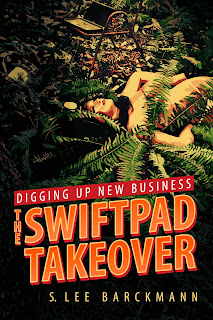
DIGGING UP NEW BUSINESS:THE SWIFTPAD TAKEOVER


Chapter 8

Jim finally meets Kip again after Years of Separation

After he left the Easy Girl Bakery, Jim rode the downtown street­car toward Powell’s Bookstore, and realized that the principal reason he moved back to Oregon was because he had no real friends in California, just acquaintances. Life was passing him by and he felt as though he had no connection to it. He didn’t know what else to do, so he went home – or the closest thing he had to it. Portland was as close as he wanted to get to Benton County. Looking around Northwest Portland made him realize it was going to take a long time, but at least there were enough potential friends in the neigh­borhood – and of course there was Chubby.

He had driven up the 101 to SFO at 4 A.M. almost every Monday for the last two years, when he could just as easily have flown out of San Jose, but they had bigger planes at SFO and he was more likely to get a first class seat (based on his airline mileage) by spending an extra 30, 40 minutes driving. Besides, there was no traffic that early in the morning, and doing 70 on that stretch of 101 was almost like flying on a magic carpet, because in daylight you could skateboard as fast as drive, and the morning after he got the letter from Chubby, Jim needed a reason to do something and he realized that even though everything he had ever done with Chubby had always backfired in the most bizarre manner, he had never had more fun, before or since.

Jim Hunt had been the first to call Kip “Chubby Welles.” As teenage stoners they had watched Rodney Dangerfield allow Bill Murray (his “talent agent” in the SNL skit) to change Rodney’s name to “Chubby Welles,” and Jim started calling Kip “Chubby” after that and they extended the persona at school with Jim acting the Impresario introducing the great “Chubby” Welles, who would straighten a nonexistent tie and deliver no-respect jokes.

“I told my Dad to take me to the zoo, he said if they want you, they’ll come and get you.” Baboom.

In any event, it seemed that everything Jim and Chubby did turned out wrong at first, but then ended up OK, often because Kip’s dad owned half the land in rural Benton County and was able to pull them out of their messes. The old man’s Christmas tree farm made millions, and he had other businesses, solid waste collection and a landfill, long-term leases for logging rights on some of the best timber still standing in Western Oregon, and he had between five and fifteen loyal Mexican workers who lived and worked on his property during the winter months, ready to take advantage of any quick and profitable project that came up. Kip’s father was one of the richest men in Oregon. He wasn’t too popular with his neigh­bors though.

Kip’s mother left when Kip was 10, and remarried. She called Kip on his birthday and at Christmas but otherwise was gone for good, with minimal remorse or regret. Kip’s dad brooded alone on his compound with only his housekeeper and her husband Enrique as company. He didn’t speak Spanish and their English was muy mal.

Kip’s father liked Jim, especially when he heard he enlisted back in 1987 right out of high school. He often said it was what Kip needed, but that line of reasoning never went very far. Kip used to tease Jim that he was the son his father had never had. And of course, there was that week when ol’ man Rehain and Jim’s mom took off together and returned separately.

So Jim decided it was time to get out of the permanent gridlock in the Bay Area and get back to the Emerald Empire. He had never had so much fun in his life as when he and Chubby roamed the rural outback of Benton County, Oregon, in spite of their bizarre parents. He realized that moving back to Portland and finding Chubby would probably be career suicide, but he didn’t care, at least it would be different, and different was what he knew he needed, not the slow death he was experiencing now.

So he flew to Portland, found an apartment that overlooked the city and had a view of the mountains. It didn’t matter where he lived, as long as an airport was handy. And now that he was going back to work for the KEG, that settled the matter.

He was thinking all of this and about the letter he received from “Chubby Welles,” sitting on the streetcar at 23rd and Lovejoy, across the aisle from a pretty girl carrying a violin case. He thought about the body they found near Blue Lake outside Gresham buried near a pumping station vault. He had just got hired at the KEG fifteen years ago, when the young intern disappeared. The cops had interviewed him and were not nice about it either. A single guy, new at the company, and suddenly a pretty girl disappeared? Made sense to talk to him. But it all got dropped when they found her car in Palo Alto. He knew who was buried out there. Elizabeth, the Easy Girl, said it was probably a homeless guy…no, she was wrong about that.

He looked at the girl with the violin case. Who was she, he thought, was she a student, a privileged daughter, or a vagabond with most of her belongings in the old faded black violin case? It wasn’t easy to tell because the line between a vagabond youth on a voyage of self-discovery and a destitute homeless waif was not always well defined. Jim had read somewhere that there were more homeless in Portland than almost any other city in the country.

They turned south on 11th, passed Jamison Square, and the upscale Pearl District condos. It appeared to be a community of café sitters, reading Willamette Week, or for the edgy ones, The Mercury. Around the square’s fountain on this unseasonably warm winter day were urban dog walkers, shirtless and sunbathing body builders, women with severely trimmed hair, wearing cut-off black Lycra jogging tights, some managing kids with toddler tethers while others, childless yuppie poseurs or young immigrants from places that no longer seemed like home, sipped coffee and looked on with anxiety disguised as stylized contempt.

As the streetcar passed some high-end condos, Jim eyes landed on Stan, the young guy from the plane, shaking out his dreadlocks, arm around a young woman who’s perfectly spheroidal glutes and rock hard tits were painted over with torn and faded $500 jeans and a size-too-small gray “Lewis and Clark” hoodie. She was look­ing at a newspaper and then up, in front of some very high end property. There goes law school, thought Jim. Good for Stan. Love conquers all.

Jim had been born in Oregon and he knew he didn’t fit in, but then he didn’t need to, he didn’t need to belong to anything other than the silent society of all those other unconnected, untethered loners. A lot of us out there, he thought. It sucks sometimes too. He should have listened more closely to Stan on the plane. He seemed to have figured it out better.

Jim got off the streetcar at Powell’s and walked up to the Burn­side door and immediately noticed it was different from what he remembered. The Burnside entrance he remembered used to be seedier and grittier and was almost always staked out by several sad people, who had written out stories on cardboard, sometimes with a punch line, a story with pathos, perhaps a lost wallet, a dying sibling, needed medical procedures, sick children, a thrown rod in an old car. But they fixed up the door and windows around the entrance since Jim’s last visit, put in more glass and now it feels a tiny bit more corporate, and streamlined, with more cashier stations. And maybe it is a little less inviting to all of the out-of-luck people who used to camp out there. Jim felt a little strange about it, like he did all gentrification.

Jim came through the Burnside entrance to Powell’s and turned left into the door toward the literature stacks passed the novels and the poetry, row after row of Classical Greek and Latin literature, Aeschylus, Euripides, Sophocles, Virgil, the two Plinys, etc., up the short steps into the detective and science fiction section. Jim stopped and found a copy of the sequel to Tinker Tailor Soldier Spy, The Honorable Schoolboy, then put it back, he wanted something with more grit and maybe more…American, something easier to read too, he thought…Chandler! There must be something Chandler wrote that he hadn’t read…oh yeah, Chubby, he was here to meet Chubby. He pulled himself away from the Noir fiction and went into the coffee shop.

Kip was sitting at a table by himself even though it was pretty crowded. He was wearing a water-stained fringed Buffalo Bill leather jacket and had a couple books about old films scattered in front of him. His serrated single blade pocket knife was opened and laid on a sketch book that displayed Chubby’s almost finished dark pencil drawing of Vlad the Impaler, whose burning, recessed sinister eyes seemed more medieval and dark than any Hollywood vision ever made. Jim could sense Chubby was making some of the other patrons nervous.

“Why did we meet here?” Jim asked, as he walked over to Kip and looked down at Vlad.

“Remember the library back in school, detentions for talking during study hall? Come here, man…” Kip got up and hugged Jim. “It has been…I was just thinking about this. It has been 18 years since we last saw each other.”

“I know, I was just trying to remember, it was here in Portland, I met you at that Chinese dive…” said Jim.

“Hung Far Low, just down the street,” Chubby said. “And that’s not even there anymore. I think it moved out to Hillsboro or maybe 82nd some place out past the buoys.”

Kip stood up and stretched. He began shoving the books into his grease-stained leather bag.
“They used to kidnap sailors to Shanghai there,” said Jim.

“Maybe.”

They continued to look at each other. “Chubby, it is good to see ya.” Kip got a little twinkle in his eye. No one had called him Chubby in years. And now, well, it began to fit, even if it didn’t when he got the nickname. “Remember when we came up here as kids? This place was like heaven. Did you look at the SciFi sections?”

Clans of the Alphane Moon,” said Kip, holding up the PK Dick novella, laughing, “The paranoids and the depressives ran the place, just like Philomath High. Principal Smith, he should have been institutionalized. The English teachers were the schizos, the coaches, and gym teachers were manics, and then there were the Heebs, the hebephrenics.”

“We were the Heebs, weren’t we?” Jim looked at Kip with awe.

“Yeah, I guess we were. The disorganized schizophrenics, major issues in the house! It is amazing we ever escaped. Powell’s saved us,” said Kip. “I am here all the time now. It is my office away from my office.”

“We met some characters hitching up to Portland.”

“Nothing we couldn’t handle though.” Chubby made a fist and a knowing look.

“When I worked at the KEG, I walked up here half the time on my lunch hour, just wandering through the stacks looking at titles and covers, and dreaming about reading it all, but you can’t live long enough, so you have to choose.”

“It the same with women,” said Kip.

“Yeah, more so. So what are you doing now?”

Kip had always looked a bit like Orson Welles, the other reason that “Chubby” Welles had stuck as a nickname. He had the same eyes, the swept back brown hair, the cleft chin and wide cherub cheeks that still seemed boyish even at 44. Chubby did what he could to accent the resemblance. He copied his mannerisms, at least those of the young, buoyant Charles Foster from the first reel of Citizen Kane. He was big, about 6’1” at least 220 lb. But the voice, the melodious voice that once you heard would stick with you, it was one of a kind; you could never get it out of your head. It was made for radio, bold, unapologetically rich and deep, like Orson Welles.

“It’s a long story,” said Kip. “For both of us I am sure. Let’s go somewhere that we can talk without whispering. I want a beer or something…”

“OK. Lead the way.”

“Fresh start, huh? I have been staying down across Nicolai, crashing in my office, it’s cool, I got it fixed up. You got my letter? I stay with this woman sometimes, I got to tell you about her, she is…too much for me by a mile. But, SwiftPad, baby! It’s in an old warehouse, I have a little corner of it, not too private, but every­body in that building is, well we have too many people. I had a great place downtown, but it got robbed, and…Anyway, last week we hired eight or nine. There will be more soon, many more, we got money flowing! Maybe I should move out, how big is your place? Come on, my truck is outside…”

Chubby had a canvas duffel bag where he kept his stuff, books, an orange iPad, his first computer, with a black Skull & Crossbones stenciled on the back, dirty clothes. When they got to the counter he opened the duffel bag, releasing the aroma of mildew and some­thing else…he quickly pulled out the books and closed the duffel bag for the duration of the transaction. It flat-out stank when he opened it.

“I have to buy these,” he said. He had copies of R. Crumb: The Complete Record Cover Collection, the first book of The Illuminatus! Tril­ogy, and The Complete Idiot’s Guide to Tantric Sex.

They got into Chubby’s truck, a 1951 Chevy pickup, and he threw his stinky duffel bag in the back.

“In your letter, you said no email. You mean, internet email?? What is that about?”
Kip looked sternly at Jim, who was smiling.

“It’s not a joke, Jimmy,” Kip said.

“I guess if you have reason to be paranoid…”

“You work for GIP for Christ’s sake!” Chubby looked ahead, working the gears on the hilly stop, and headed up toward North­west Portland, where Jim had just come from.  They ended up on 23rd, across the street from the Easy Girl Bakery, found a parking spot and Kip led Jim into the Nob Hill Bar. Jim paid for a couple of beers and they sat in the back away from the other customers.

“You ever eat over there?” asked Jim.

“Easy Girl? You kidding? Lizzy and I go way back. I met her at the Sturgis Rally ten years ago. I’m in there more than I should be; the pie is too good, gotta watch my figure.”

“She seems nice. I stopped in this morning…” They ordered beer at the bar, found a table and sat down. “So how about you? Tell me about your girlfriend.”

“It’s not just her. But yeah, we’re business partners, which is probably not a good idea.”

“What’s not a good idea, fucking or business?”

Chubby thought about that for a few seconds. “Which brings me to what I want to talk to you about.”

Jim shook his head and rolled his eyes.

“I have finally hit the mother lode! I am helping to run a soft­ware start-up, like I told you.”

“Well, I have a job. I am not looking for another one right now.”

“I am not talking about a job! First, I need to vet you. GIP? How can you work for them? Jesus, I have to say that concerns me. You are like some demon coming up to Heaven and saying, “Yeah, I’ve been working for Satan, but I think it would be cool to hang out with you guys now.” Kip lowered his head to sip his beer and looked at Jim through half closed eye slits, suddenly morphing into Sheriff Hank Quinlan from Touch of Evil.

“Fuck you, you fat fuck.”

“That doesn’t matter. You would be working with me,” said Kip.

“When you say working…you mean you pay people…”

“Soon, yeah, but now we have some subsidies, we are always having open dinners for everyone and we have some contingency funds…but that is changing fast. We just signed up with some investors and…”

“Kip, I need to make money. Anyway, I am going back to the power company. I start next week.”

“But you can still quit that. Or do both! This is going to be big. We will be rich! Richer than my Dad, within a year. What are your expenses? Are you supporting anyone? Any kids you know about?”

“No, but still…”

“OK. Can you keep an open mind? If I take you over there, can I say you are thinking about it?”

Jim smiled and for about 30 seconds stared at Kip, who never cracked a smile or broke eye contact.

“Yeah, I’ll think about it. What is your position in all this?”

“I told you, I am one of the founders and I squeezed some seed money from out of my trust, anyway, it is all on the up and up. Investment, depreciation, tax stuff. You know what I mean? Now we have real investors. I am designing the overall…ya see, it is GG and I who kind of came up with the concept. There are about three of us, four…no five of us running it…But if you came on board…we just formed a board of directors and like I said, money is about to flow ,my friend! And with your experience and my recommendation…”

“OK, OK, don’t get ahead of yourself. Alright. This is software, right? I mean your product?”

“Well in part. Yes. It is a…it started as a Facebook rip-off. But it is taking off…!” said Kip.

“You mean you are going to sell advertising like…”

“No. Well, yes, but…” Kip shook his head like he was tired of talking to idiots. “You still don’t get it,” said Kip. “But that’s OK. We don’t have all the answers yet either, so you can help us answer those questions.”

Jim made a face and looked away, then back at Kip.

“It’s good to see you, buddy.” said Kip. “We’ll figure some­thing out.”


Chubby's Next Adventure is Starting Now


DIGGING UP NEW BUSINESS:THE SWIFTPAD TAKEOVER


Buy the book!


I finally published my second novel, “Digging Up New Business: The SwiftPad Takeover” (SwiftPad). I am going to try to describe how I came to write it. This will be interesting for me because up until this very moment, I have not really thought about it, because I was so engrossed in the process of writing and publishing it.


I had a brilliant editor in Linda Franklin, whose input turned a blob of a manuscript into something readable. It would take a long time to explain all of the little things she did to polish the manuscript. Sometimes she seemed to understand what I was trying to say better than I did. It was my first experience working with a truly professional editor and it was a master class for me in how to prepare a manuscript.


My characters are a mishmash of the characteristics of real people I have known, but mostly they were invented out of my own musings. One real person from whom I modeled a lead character I will talk about a bit, because he had such a profound impact on me. Kip (Chubby) Rehain is based in part on Ross McConnell.

Ross is celebrated by other people who have known him.

Here

http://www.mjville.com/?cat=7

and here

http://rossmcconnell.blogspot.com/

Neither of the two links above discuss Ross's time in Oregon – he lived in a number of places – I know he flunked out of Harvard at least twice – and was in Eugene Oregon between 1978-1983 or so. That is where I met him. Anyway – I thought of him more than once or twice as I modeled the character Kipling 'Chubby” Rehain. Of course the character Kip is from a different generation than Ross and had a much different experience growing up, but I thought what would Ross do, when I wrote him. The real Ross is one of the great friends I will ever have. He died several years ago in Georgia (the one in the Caucasus, not Confederacy) and some of the circumstances are described above. As you can see he had a powerful influence on more people than just me.  Some even seem to see him in a religious context, which if nothing else shows you the power of his personality.

THE PLAN -. My first novel, Farewell the Dragon started out as a memoir, but I quickly saw that I needed to make it fiction for a number of reasons. The most important reason of course was to protect my Chinese friends from identification.

A 1st person novel based on a memoir can pose a number of technical problems, none of which I was aware of when I started, but I learned them as I went. The most obvious is that the reader can only know what the main character knows, so you have to maneuver the character so that the story flows in a way that keeps the plot going and the reader interested. The benefits of 1st person are many – it is more immediate and compelling if done right. But it isn't easy.

So, with SwiftPad, I wanted to write in 3rd person as an exercise in craft if for no other reason. With 3rd person you can tell the story anyway you want, but the problem is to keep the reader interested and not fall off into a blather of narrative that gets too far away of the the character's problems – which is all most reader's really care about. . Different problems – 1st person is more immediate and compelling, but it is harder to sustain in someways. With 3rd person you can tell any kind of story you want if you can keep the reader interested.

My frame of reference as a writer is the big story, epic world shattering story. I know this is sensationalism to a degree – and I think as I mature as a writer – (in 13 days I'll be 64 but I am still very much a kid when it comes to writing) my focus will become narrower. But – maybe not. Anyway – I am at the age where I have stopped buying green bananas so lets not get ahead of ourselves. What I mean by that is that story has to have significance beyond the character's immediate circumstance. Whether it it is Nate in Farewell the Dragon looking for that archaeological artifact that will change the way people think of history, or GG creating a Social Media application that will surpass Facebook and Twitter – the story had to be big, above and beyond the character's themselves.

I wanted the story to be about a place – and since I live near Portland, that seemed like the likely spot. I certainly can't write about Beijing anymore – that city, the city of my memory and imagination is gone forever. The traffic jams are no longer populated by bicycles, but by freeways that turn into automobile parking lots throughout the day. When I was there the tallest building had about 13 stories – and it stood out as a lonely spire, like the WTC used to in NYC. Now many fifty story buildings (and higher) are densely packed in the center of the city. I almost don't want to go back, so the memory of what it was in the mid 80's stays fresh.

I live in a somewhat secluded suburb of Portland now, 'bike friendly' (I don't get in my car unless it is absolutely necessary) and close to Portland. I am not a social person, so I wouldn't hang out in coffee shops or parks, or spend weekend nights at the Roseland watching new bands much anyway. My days of crashing music venues ended in Eugene Oregon in the 80s, which as I said was a pretty good time. So when you see me, I am usually the strange guy over in the corner, you might catch his eye occasionally but mostly has his head down in a book, peeking up to observe occasionally, when others had their attention elsewhere.

I worked in downtown Portland through the late 90s and my wife worked there for the last six years. And I would spend at least one day a month just hanging out in the city, visiting Powell's Books, going to an 'arty' movie, hiking through Forest Park sometimes, or trying out a new restaurant. Mostly I wandered the streets watching, imagining I was Charles Bukowski or Fyodor Dostoyevsky.

After leaving my job in the City, I became an IT consultant, which meant I had to fly to the job. On Friday I would land at PDX returning from where ever I was working and Mary would meet me at the airport, and we would celebrate another beginning of the weekend, (which would end so so soon), eating and drinking in the City, and then we would drive back to our southern most Portland suburb to sleep and get ready for the next week.

So I am an observer of Portland. Not a distant observer of Portland but not a real close one either. I don't really have that feeling of living in town, hearing the traffic, and smelling the food carts, and the river as a background to my life. I think maybe being a frequent visitor rather than a resident helped me see things that normally would be hidden as a part of the subconscious soundtrack of life.

I wanted to write about what I know – and to say goodbye to my career as an IT consultant. Let me tell you a bit about that. Mostly I feel like I faked it for 30 years.

Not at first – when Mary and I returned from China in late 1987, I had to make a living. Zach was about to be born and I was 36 without a clue as to my next step. In my mind our return to the US was just temporary. I intended to get back to China. I had attempted a business there and failed, but I knew if I had another chance, I could make it there.

But I never went back.  After two years selling computers in Florida and after encountering Jeb! Bush who I tried and failed to sell a computer to for his 'real estate' business, Mary, Zach and I returned to Oregon, where I continued my 'IT' career.

Ten years later I was a 'Consultant' and It lasted almost twenty years after that.

The hard part of course has been navigating the technical changes that have occurred in the industry, and that is the part I faked. But it didn't matter, because soon I realized it was mostly smoke and mirrors for almost everybody else too. Maybe some other time, I'll tell you what I mean by that. But probably not, because, as I said, Digging Up New Business: The SwiftPad Takeover is my Computer business Swansong, and now I am off again on to whatever is coming next. At least before the sure and certain end of it all.

Anyway, I wanted to write about my IT experience and capture some of the feel for what IT as a job really means. That part is tricky, because technical stuff in a novel poises serious risk of becoming boring.

But Melville did it (Moby Dick is nothing if not a technical manual that could have had an alternate title of 'How to Catch Whales in the mid 19th Century'. And Thomas Pynchon's 'Gravity's Rainbow' is an Aeronautical Engineer's wet dream.) So it could be done – but by me? Certainly not, at least not yet.

Finally, well – to sell a novel, and to catch the fancy of those readers who are not true bibliophiles, you gotta spice it up. Suspense, psychological abnormality and murder have show up if you want anybody to read it. I actually have no problem with that, either technically or morally. Call me Iago if you want, but for some reason I know the drill. I suspect most people do too, even if they don't admit it.

So to sum it up, I wanted to write a novel in 3rd person, based in Portland, about the IT business with a character who is a serial killer.

But in good fiction, character is the only thing that really matters. I suppose that is not completely true, because there are many novels that are vehicles that carry the stories of societies, both real and imagined, big and small, stories that the setting or ideas overshadow the characters. But the great stories, in my opinion have multiple messages, messages about the implications of the way we live, or of political systems imposed on us, or the changes that nature and history seem to cause with little regard of people. But at the same time those great novels also tell a story about people, and their inner-lives and their relationships with other people.

To me that is the Holy Grail and while it is an act of incredible hubris to think that I can write a novel like that, there is nothing else I can think of that is worth trying. I know I have not yet done it. I am not unhappy with what I have done so far, but I know it does just scratch the surface of what I can do. (There is your hubris!). As long as I stay healthy, (and at my age that becomes a bigger “if” with each passing day) I am going to try.

So what is next? Well – questions of genre seem to be important to some people when they judge literature. In fact some genres are not even referred to as 'literature' by some of the Ombudsmen of the Odes. And the genre I am going for next is going to be the mystery story, where a slightly seedy, no longer young man, who has a known persona, and lives in a known place, is pulled into someone else's life the results of which might be life or death. A mystery story, like John MacDonald writes.

That means that 'Chubby' Rehain is not done. THE SEQUEL – perhaps titled something like 'Digging Up New Business: 'STORY NAME HERE' – is on the way. I'll not detail his circumstances, but Kip Rehain will be be much the same as we find him in 'The SwiftPad Takeover – living in Portland, with a few half-assed project on simmer, looking for a way to stay sane in a world that has given him everything except what he really needs – a reason to be. I hope to have it done by March.

I'll be posting drafts and excerpts. Like before – I not leave them up long – because I know my first efforts will 'need work' to say the least.

I can't think of a better way to spend the winter in Wilsonville, which is near but not in Portland..